
Lesson 14 — 1983: Six Hundred Fifty Races, One Government
Constituencies, Crosses, and a Crown
Picture yourself as a voter in Finchley, in north London, on Thursday, June 9, 1983. You step into a wooden booth with a paper ballot. It lists 11 candidates. One of them is Margaret Thatcher, the Prime Minister of the United Kingdom. But the ballot does not ask you to choose a prime minister. It asks you to choose one Member of Parliament, or MP, for Finchley, and you may mark a cross beside only one name. On the same day, in 649 other places, other voters choose their own members. Nobody in the country votes for prime minister at all. Yet by morning the country will know who governs it. Here is the puzzle. Thatcher's Conservative Party won 42.4 percent of the votes and 397 of the 650 seats, more than 6 in every 10. The Alliance won 25.4 percent of the votes and only 23 seats. How can about four votes in ten become six seats in ten? The answer lies in how the British count: . Here is what was at stake. Britain had just won a war in the Falkland Islands, unemployment had climbed to levels not seen since before the Second World War, and three parties offered three very different roads. At MockElection.com we want to make you a scholar of the republic. Let's see how another people chose.
A Kingdom With a Parliament
The United Kingdom is a constitutional monarchy: a country with a king or queen as head of state, governed under laws and customs the monarch must follow. In 1983 the monarch was Queen Elizabeth II. She did not run the government. The lawmaking power lay with Parliament, and above all with the House of Commons, the elected chamber. The upper chamber, the House of Lords, was not elected. In 1983 the Commons had 650 seats, up from 635, after the boundaries of the seats were redrawn.
The Prime Minister is not elected by the whole country. He or she is a member of the Commons who leads the party, or group of parties, that can win its votes. Thatcher was the member for Finchley, and she was Prime Minister because her party held a majority of the seats. So in Britain, the voters choose the , and the members decide who governs.
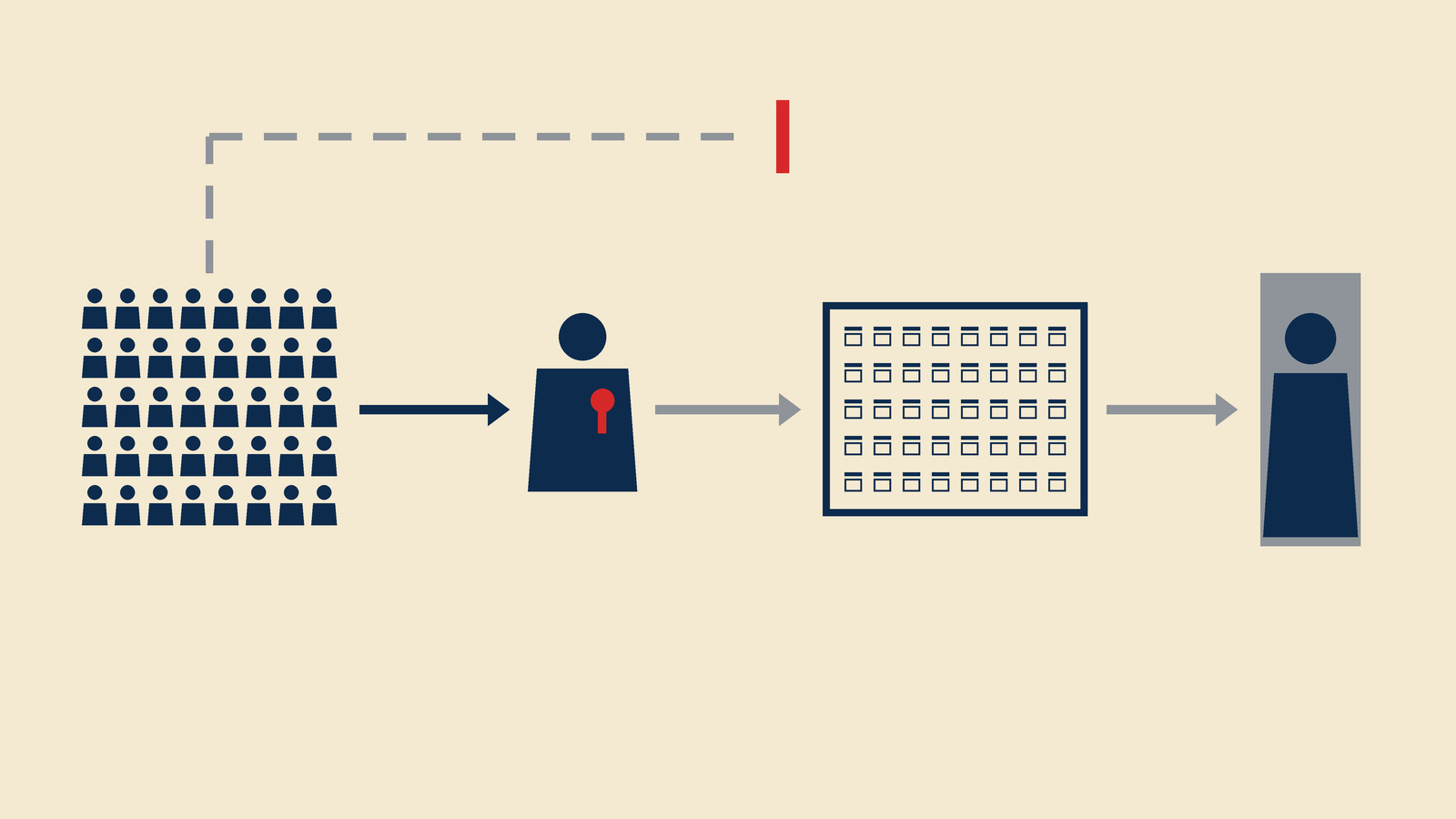
In 1983 Britain's Prime Minister chose the day of the election, as long as it came within five years. Which way would you rather a country set its election day?
Six Hundred Fifty Races
A British general election is not one race. It is 650 races held on one day. In 1983 England had 523 seats, Scotland 72, Wales 38 and Northern Ireland 17. Each seat was a constituency, a district that elects one Member of Parliament.
To get on the ballot, a candidate needed a nomination paper signed by ten voters of the constituency: a proposer, a seconder, and eight more. That rule dated from the Ballot Act of 1872, the law that first gave British voters a secret ballot. The candidate also paid a deposit of £150 to the returning officer, the official who runs the election in that constituency. A candidate who won one-eighth of the votes or less lost the deposit. In 1983, 2,578 candidates stood, and 739 of them lost their deposits.
Three parties ran across most of the country. The Conservatives, led by Thatcher, asked for a second term to continue selling state-owned industries and limiting the power of the trade unions. Labour, led by Michael Foot, put its plan in a 39-page manifesto, a party's written program, called The New Hope for Britain. It called for Britain to give up its nuclear weapons without waiting for other nations, and to leave the European Economic Community. The third force was new. In March 1981, a group of Labour members had broken away to found the Social Democratic Party. It joined the old Liberal Party in an alliance, and the two stood together as "the Alliance." In September 1981, the Liberal leader David Steel told his party's conference to go home and "prepare for government." By November 1981, one poll put the Alliance at 42 percent. Then, on April 2, 1982, Argentina invaded the Falkland Islands, and by June 14 British forces had taken them back. The polls turned toward the government.
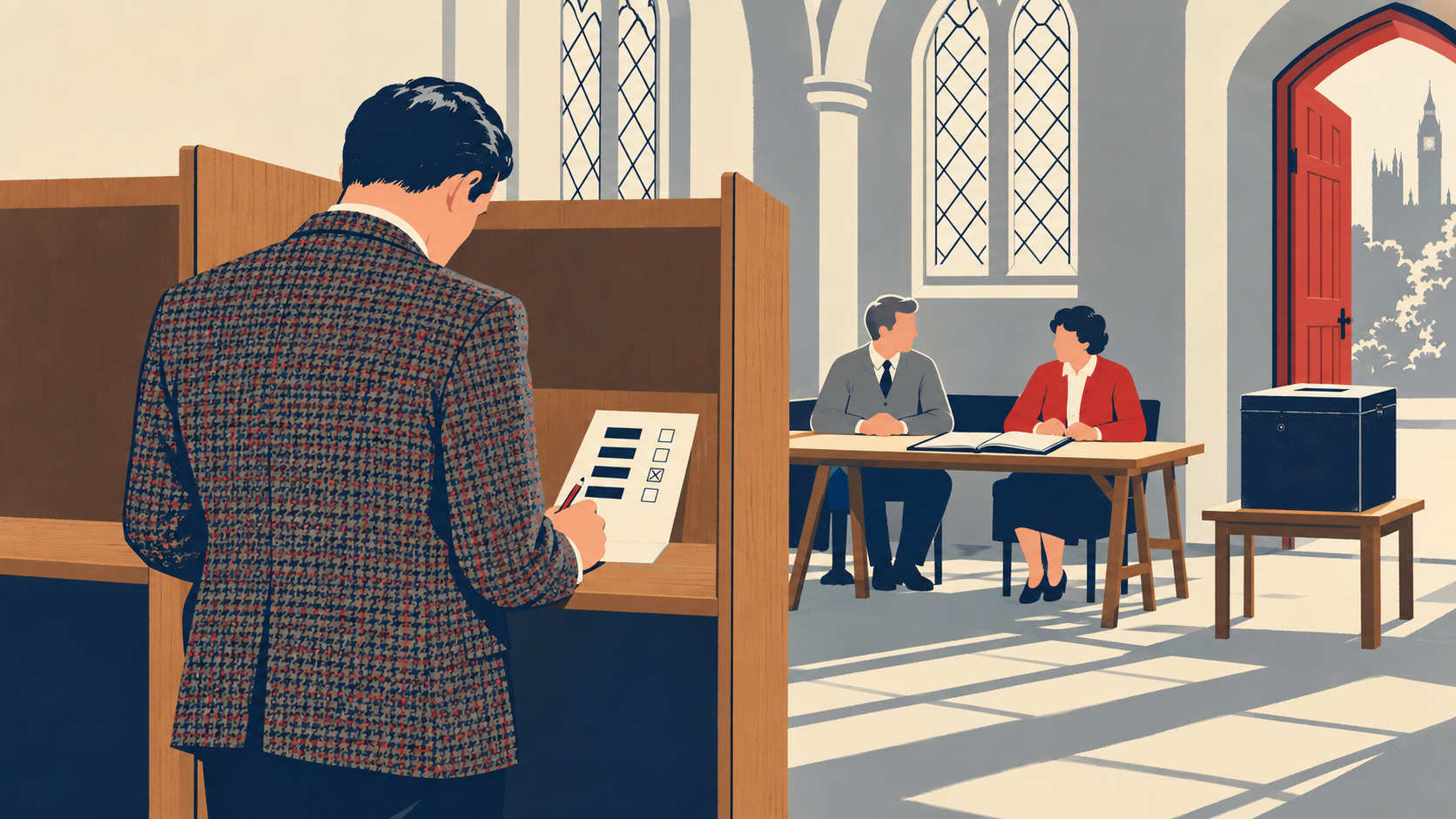
Election Night
The polls closed at ten. Just after eleven, Thatcher left 10 Downing Street for the count in Finchley. "We think this will be our home for the next five years," she said as she went.
In Finchley, 38,417 people had voted, 69.0 percent of the voters there. Thatcher won 19,616 votes, 51.1 percent. Laurence Spigel of Labour won 10,302, and Margaret Joachim of the Liberals won 7,763. Eight other candidates shared the rest, from the Ecology Party's 279 to the 13 votes of a candidate standing for a party called Belgrano Blood-Hunger. One-eighth of the Finchley vote was 4,802, so all eight lost their deposits. Thatcher's majority over Labour in her own seat was 9,314. She had been elected again, not as Prime Minister, but as the member for .
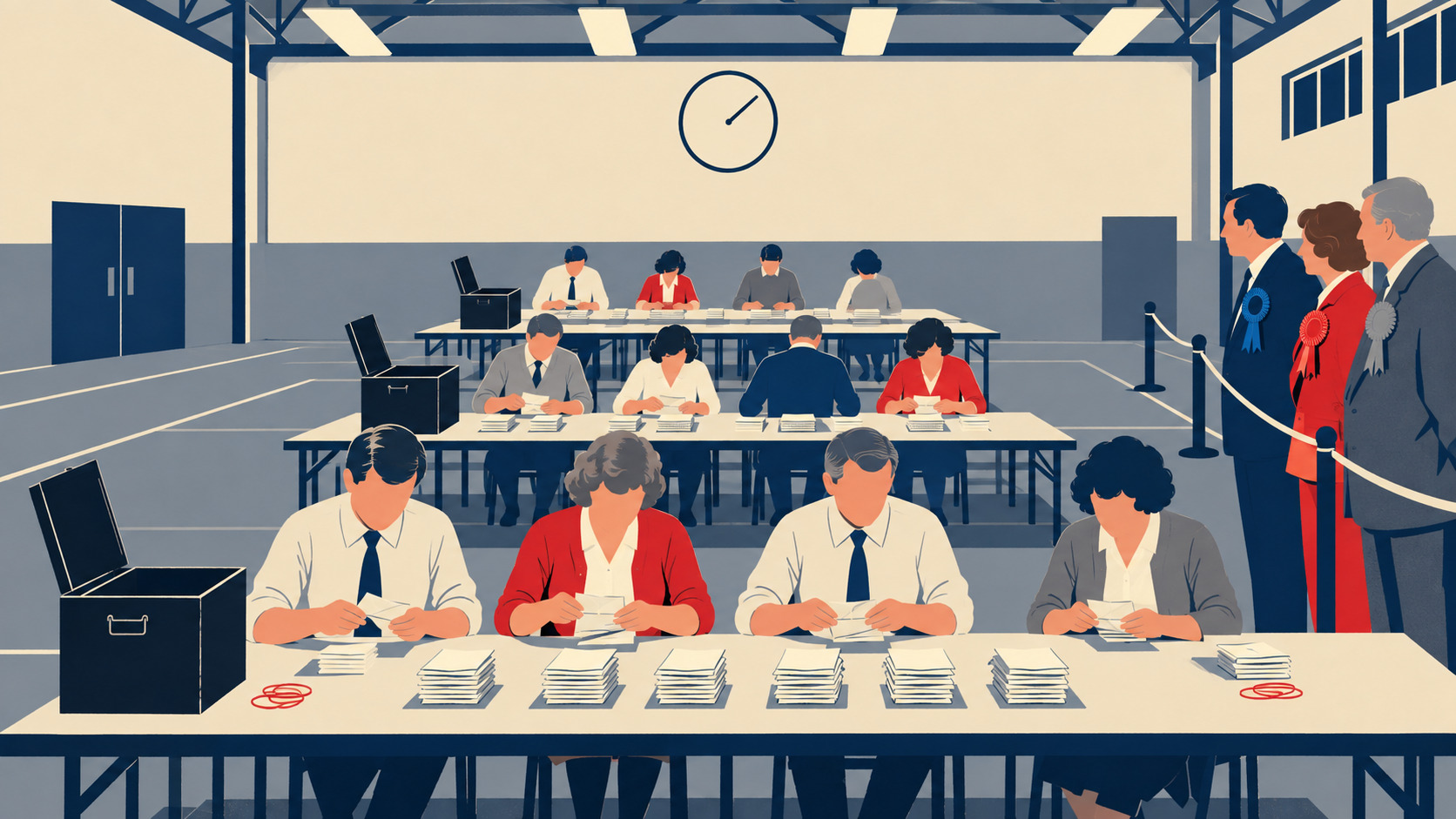
Across the country the same count ran in 650 halls. When it was done, the Conservatives had 397 seats, a majority of 144 over all the other parties combined. It was the most decisive result since Labour's majority of 146 in 1945. Labour won 209 seats, its fewest since 1935. The Alliance won 23.
Some of the best-known members of the Alliance lost. Shirley Williams, who had helped found the Social Democratic Party, lost the seat she had won in a by-election in 1981. So did the Liberal Bill Pitt. Labour's own losses ran deep: across the country, 119 Labour candidates lost their deposits.
How Forty-Two Became Sixty-One
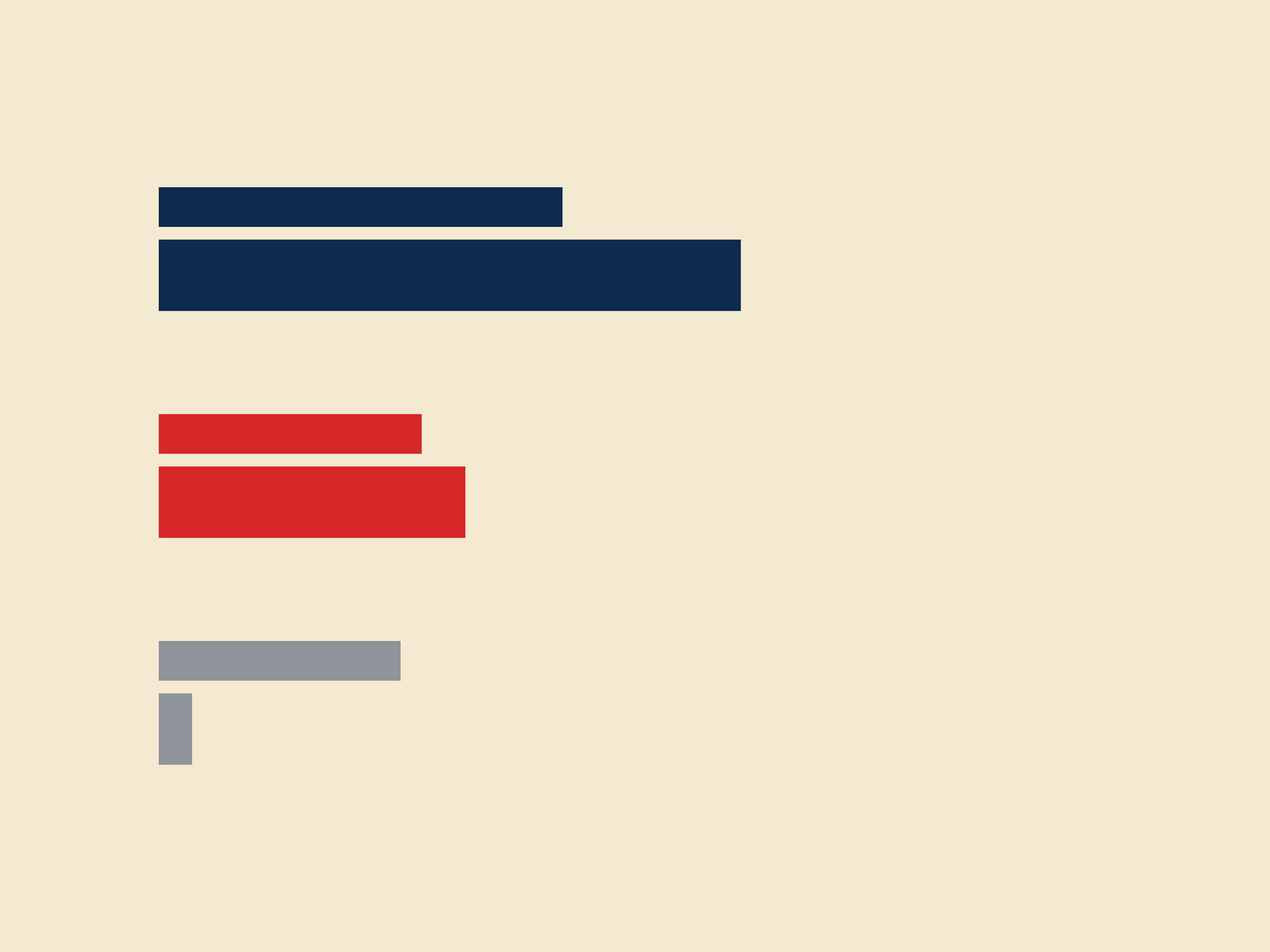
How did 42.4 percent of the votes become 61.1 percent of the seats? Each seat was its own race, and a candidate needed only more votes than anyone else in it. Where three parties split the vote, a candidate could win with well under half. The Conservatives finished first in 397 constituencies, often by a margin over two rivals who divided the rest. Labour's support was concentrated in particular regions, where it still came first, and so it won 209 seats. The Alliance had no such heartland. Its votes were spread across the whole country, and it came second in place after place, and second place in a constituency wins .
As you recall from the election of 1984, American states hand out their electors in a similar way. Ronald Reagan won 58.77 percent of the popular vote and 525 of 538 electors, 97.6 percent. In both countries, a narrow lead in a district or a state counts the same as a wide one, and the winner's share of the seats or electors runs ahead of his share of the votes.
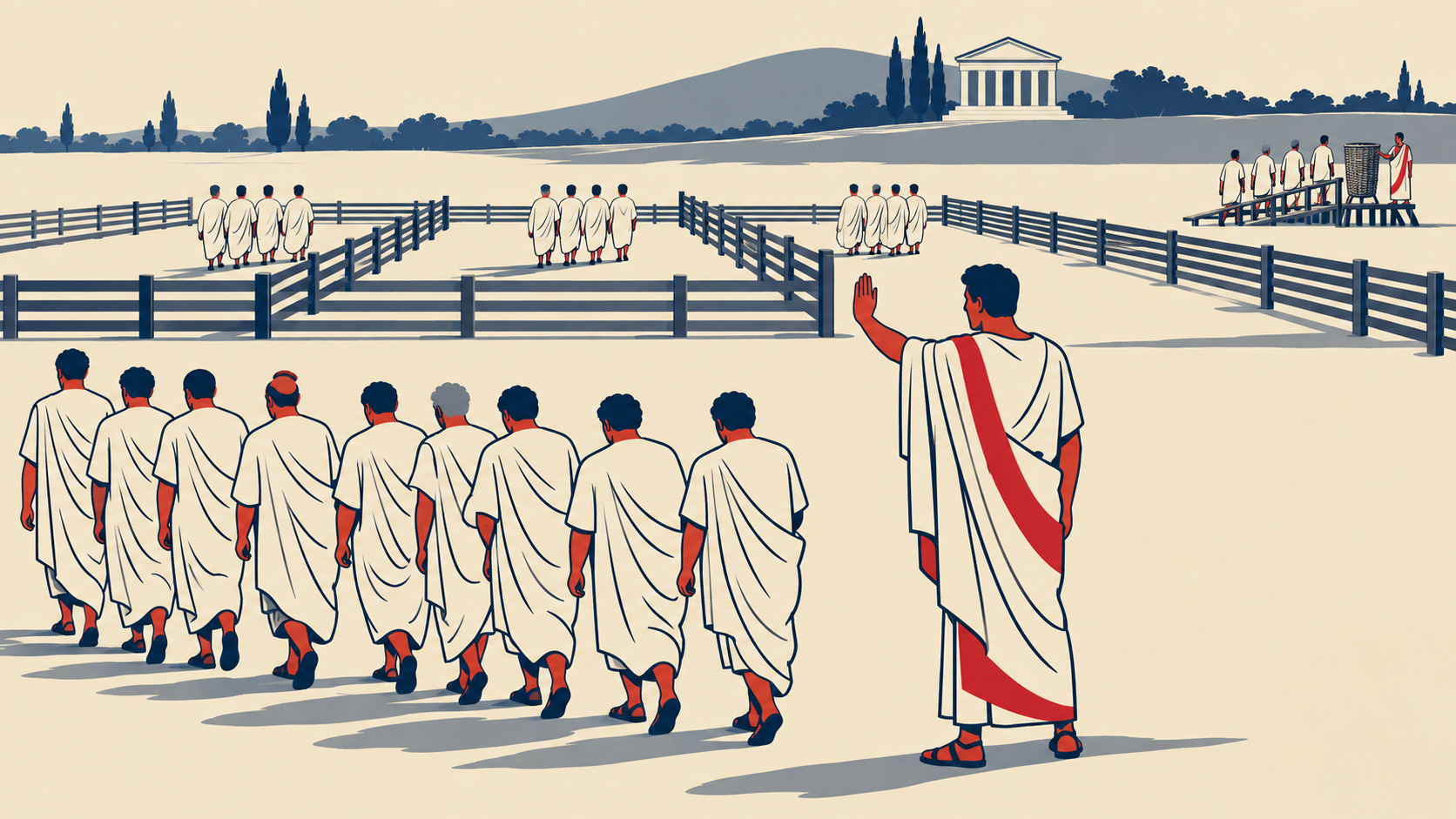
The Liberals had argued for years for a different rule, proportional representation, in which each party wins seats in proportion to its share of the votes. Under an exact share of 650 seats, the Alliance's 25.4 percent would have come to about 165 seats, not 23, and the Conservatives' 42.4 percent to about 276, short of a majority. Under first past the post, each constituency kept one member of its own, and a single party won enough seats to govern alone. Thatcher won three elections this way, in 1979, 1983 and 1987, and never once won more than 44 percent of the vote.
The Justice of the Count
The virtue this election tested was justice: giving each his due. But what is a voter's due? One side said it is the same rule for every constituency, applied the same way everywhere, with the winner taking the seat. The other side said it is a share of seats that matches the share of votes. Both appealed to justice. They disagreed about what was owed.
Aristotle saw this argument coming. He wrote that justice in sharing things out is a kind of proportion, and that quarrels arise when equals receive unequal shares or unequals receive equal ones. He also wrote that a law, because it speaks in general terms, will sometimes miss the just result in a particular case, and that the wise man corrects for this by equity rather than by breaking the law.
The men who lost in 1983 applied justice in two ways at once. They gave the result its due. Michael Foot did not dispute the count; he stepped down, and on October 2, 1983, Labour chose Neil Kinnock to lead it. And the Liberals kept arguing, in Parliament and in public, for a new rule. They honored the count under the old rule while they worked to it.
Conclusion
Go back to the booth in Finchley on June 9, 1983: eleven names, one cross, and a ballot that never once used the words "prime minister."
How the map changed. The Conservatives won 397 of 650 seats and a majority of 144 with 42.4 percent of the vote. Labour fell to 209 seats. The Alliance won 25.4 percent, the best result for a third force since 1929, and 23 seats. In 1985 Parliament debated those 739 lost deposits and changed the law. From October 1, 1985, a candidate paid £500 and kept it with more than one-twentieth of the vote, instead of one-eighth. In 1987 Thatcher won again, with 376 seats on 42.2 percent and a majority of 102.
How the republic's character moved. Britain's voters had chosen a government without ever voting for its head, through 650 local choices added up in one night. The result was decisive, and the losers accepted it and took their arguments back to Parliament. A people that accepts the count, and keeps the right to argue about the rule, can change its government without breaking anything.
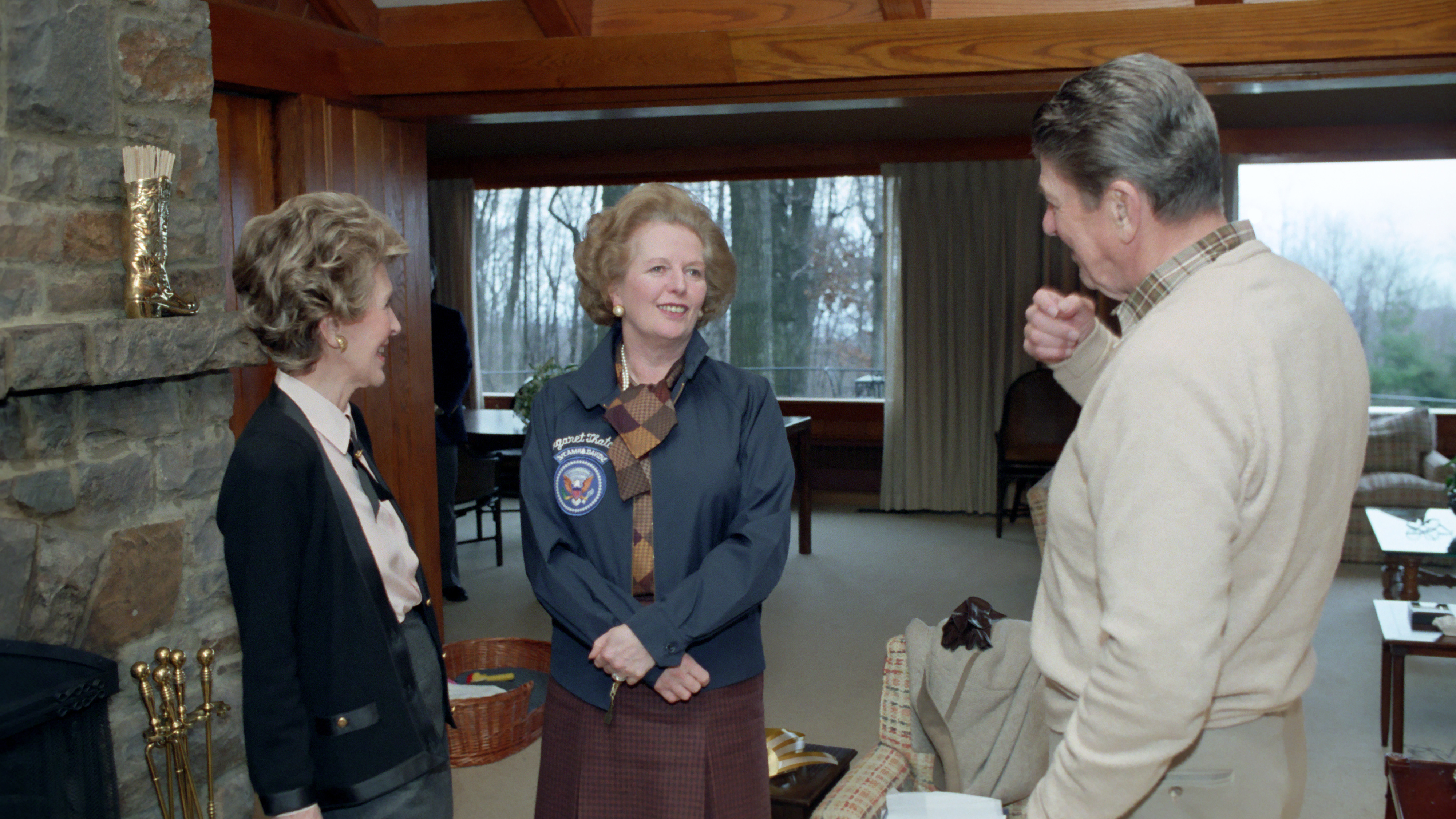
That government did not stay home for long. As you recall from the election of 1984, Reagan won his second term on November 6. Six weeks later, on Sunday, December 16, 1984, Thatcher welcomed Mikhail Gorbachev, then a rising member of the Soviet Politburo, to lunch at Chequers. Their talks ran past the time set to end them.
Three lessons, three ways of voting. In China in 1954, 1,210 ballots carried one name. In the Soviet Union in 1989, voters struck out the names they rejected. In Britain in 1983, 2,578 candidates stood, and voters chose among them with a single cross. It was one election in the whole true history of the vote.
To live well is to give each person his due, to honor a lawful result you dislike, and to argue openly for a better rule.
Because elections are won and lost.
Parties rise and fall.
But the republic rests on its citizens.
Lesson Summary
Key Terms
- Constitutional monarchy
- a country with a king or queen as head of state, governed under laws and customs the monarch must follow.
- House of Commons
- the elected chamber of the British Parliament; in 1983 it had 650 members.
- Dissolution
- the formal end of a Parliament, which sends every seat back to the voters in a general election.
- Constituency
- a district that elects one Member of Parliament.
- Member of Parliament (MP)
- a person elected to the House of Commons for one constituency.
- Deposit
- money a candidate pays to stand for election, lost if the candidate wins too small a share of the vote; £150 and one-eighth of the vote in 1983.
- Manifesto
- a party's written program for government.
- Plurality
- more votes than any other candidate, whether or not more than half.
- First past the post
- the rule by which the candidate with the most votes in each constituency wins its seat, and no one else wins anything there.
- Proportional representation
- a rule in which each party wins seats in proportion to its share of the votes.
Cause-and-Effect Chart
| Key Fact | The Cause | The Effect |
|---|---|---|
| Election held June 9, 1983 | Thatcher asked the Queen for a dissolution on May 9, a year before she had to | Parliament dissolved May 13, and every seat went back to the voters |
| 397 seats on 42.4 percent | Each constituency was won by a plurality, and the Conservatives came first in 397 | A majority of 144, the most decisive result since 1945 |
| The Alliance won 23 seats on 25.4 percent | Its votes were spread evenly, so it came second in place after place | About 338,302 votes for each seat it won |
| 739 lost deposits | 2,578 candidates stood, and many won one-eighth of the vote or less | From 1985, a £500 deposit and a one-twentieth threshold |
| Gorbachev at Chequers | Thatcher invited senior Soviet figures to Britain | "We can do business together," and a new opening between the Cold War powers |
Timeline
| Person / Event | Date (AD) | Description |
|---|---|---|
| The Social Democratic Party is founded | March 26, 1981 | Members who broke away from Labour found a new party, soon allied with the Liberals. |
| Argentina invades the Falkland Islands | April 2, 1982 | British forces retake the islands by June 14, 1982. |
| Thatcher asks the Queen for a dissolution | May 9, 1983 | The election is set for Thursday, June 9. |
| Parliament is dissolved | May 13, 1983 | All 650 seats go back to the voters. |
| Election Day | June 9, 1983 | Conservatives 397 seats on 42.4 percent; Labour 209; Alliance 23 on 25.4 percent. |
| Kinnock succeeds Foot | October 2, 1983 | Labour chooses a new leader after its defeat. |
| Gorbachev at Chequers | December 16, 1984 | Thatcher and Gorbachev talk past their scheduled end; the next day she says they can do business together. |
| The new deposit rule | October 1, 1985 | Candidates pay £500 and keep it with more than one-twentieth of the vote. |
COMMAND QUESTIONS
Factual Recall
The "Why" Questions
Write a short paragraph answering each question in your own words, in your notebook. Then check its box: +4 each.
The Alliance won 25.4 percent of the votes and Labour 27.6 percent, yet Labour won 209 seats and the Alliance 23. Using the text, explain why in two or three sentences.
No British voter cast a ballot for prime minister in 1983. Explain how Margaret Thatcher nonetheless remained Prime Minister after the election.
Cast Your Ballot
you are a Finchley voter on June 9, 1983 — mark one cross beside one candidate; the candidate with the most votes wins the seat, even without a majority
Loading…
The ballot: 1983 — Member of Parliament for Finchley (one cross, one candidate; most votes wins)
Margaret Thatcher — Conservative — the sitting member for Finchley since 1959 and Prime Minister since 1979; asked for a second term to continue selling state-owned industries and limiting the power of the trade unions
Laurence Spigel — Labour — for the party's program The New Hope for Britain: government action to rebuild industry and jobs, giving up Britain's nuclear weapons without waiting for others, and leaving the European Economic Community
Margaret Joachim — Liberal, for the SDP–Liberal Alliance — the Alliance's "Working Together for Britain," with a promise to cut unemployment by up to 1,000,000, and a new voting rule of proportional representation
Also on the ballot: Simone Wilkinson (Ecology); Screaming Lord Sutch (Monster Raving Loony); Anthony Noonan (Ban Every Licensing Law Society); Helen Anscomb (Rail Not Motorway); Anthony Whitehead (Law and Order in Gotham City); David Webb (Anti-Censorship); Brian Wareham (Party of Associates with Licensees); Benjamin Wedmore (Belgrano Blood-Hunger)
What a voter knew on June 9, 1983:
- The election had been called a year early, on May 9, and Parliament dissolved on May 13.
- British forces had retaken the Falkland Islands on June 14, 1982.
- Unemployment stood at levels not seen since before the Second World War.
- The Alliance had led one poll with 42 percent in November 1981, but the polls had since turned toward the government.
- A vote for Thatcher in Finchley was a vote for one Member of Parliament; it would keep her Prime Minister only if her party won a majority across the country.
What the voters decided: Margaret Thatcher, 19,616 (51.1 percent), elected with a majority of 9,314; nationally, the Conservatives won 397 of 650 seats.
Cast your own ballot on MockElection.com — vote as a citizen of Finchley in 1983, with only what a citizen of Finchley in 1983 knew. Then compare your count to history.
In 1983 the Alliance won 25.4 percent of the votes and 23 of 650 seats. If you could set the rule for electing Britain's House of Commons, which would you choose?
Two games wait below
Whistle-Stop
The lesson’s words, against the clock. Twelve in a row earns the Blue Ribbon.
The Canvass
Match each cause to its effect, then each event to its year. Both boards with one miss or fewer earns the Clean Count.
0 of 100 points
Kept in this browser for this visit. Sign in to keep it on any device.