
Lesson 5 — 1876: Twenty Votes in Doubt
A Commission, a Compromise, and the End of Reconstruction
On February 1, 1877, the Senate and the House of Representatives meet together in the Capitol to count the electoral votes. Senator Thomas Ferry of Michigan opens the certificates one state at a time, in alphabetical order. Then he reaches Florida, and Florida has sent not one certificate but three. Louisiana, South Carolina and Oregon have each sent two. One candidate, Samuel J. Tilden, holds 184 electoral votes that nobody questions. He needs 185. His rival, Rutherford B. Hayes, holds 165. Twenty are in . When a state sends two answers, who decides which one is true? Here is what was at stake. The new president's term began on March 4, 1877. If no one could settle the count by then, the republic might have no lawful president, and the same answer would decide the future of the South. At MockElection.com we want to make you a scholar of the republic. Let's see how a free people chose.
One Elector Short
As you recall from the election of 1860, seven Southern states voted to leave the Union after it, and a civil war followed. The years after the war are called Reconstruction: the time when the national government worked to rebuild the Southern states and bring them back into the Union. More than half a million Black men became voters in the South during the 1870s. By 1876, Republicans held power in only three Southern states: South Carolina, Florida and Louisiana. Federal troops were still stationed in all three, and in Louisiana and South Carolina soldiers guarded the statehouses where the Republican governors sat.
In June 1876, in Cincinnati, the Republicans named Governor Rutherford B. Hayes of Ohio for president and Congressman William A. Wheeler of New York for vice president. In St. Louis, the Democrats named Governor Samuel J. Tilden of New York and Governor Thomas A. Hendricks of Indiana. A third party ran too. The Greenback Party, founded in 1874 mostly by farmers and farm workers hurt by the Panic of 1873, wanted the government to print more paper money, called greenbacks, to raise farm prices, ease loans and lighten debts. It named Peter Cooper of New York, 85 years old, the man who built the Tom Thumb steam locomotive.
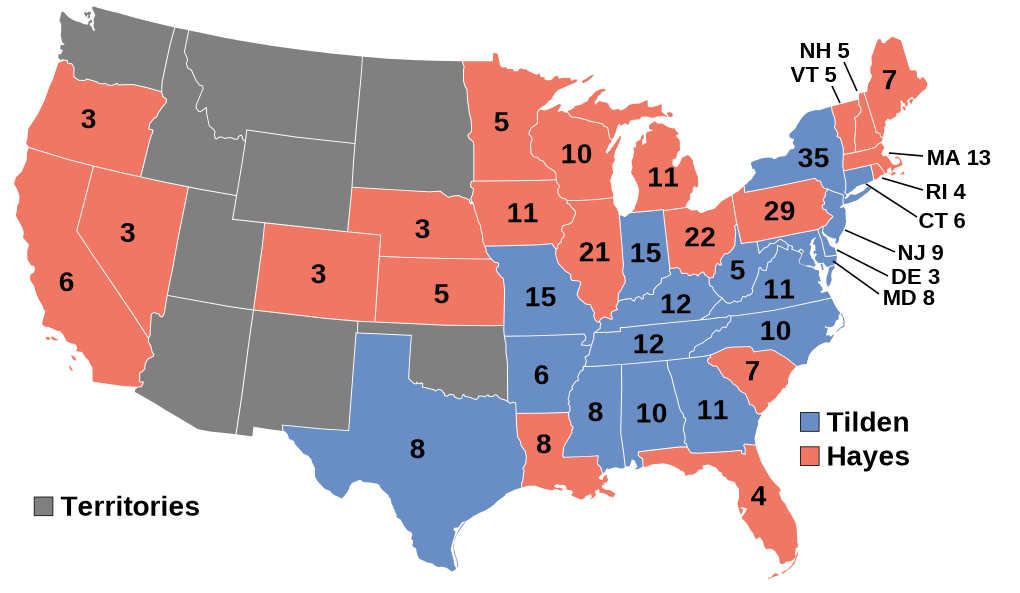
Tilden won 50.9 percent of the popular vote. That is a popular majority: more than half of all votes cast, not just more than anyone else. He led Hayes by 264,292 votes. But choose the president, and Tilden was one elector short.
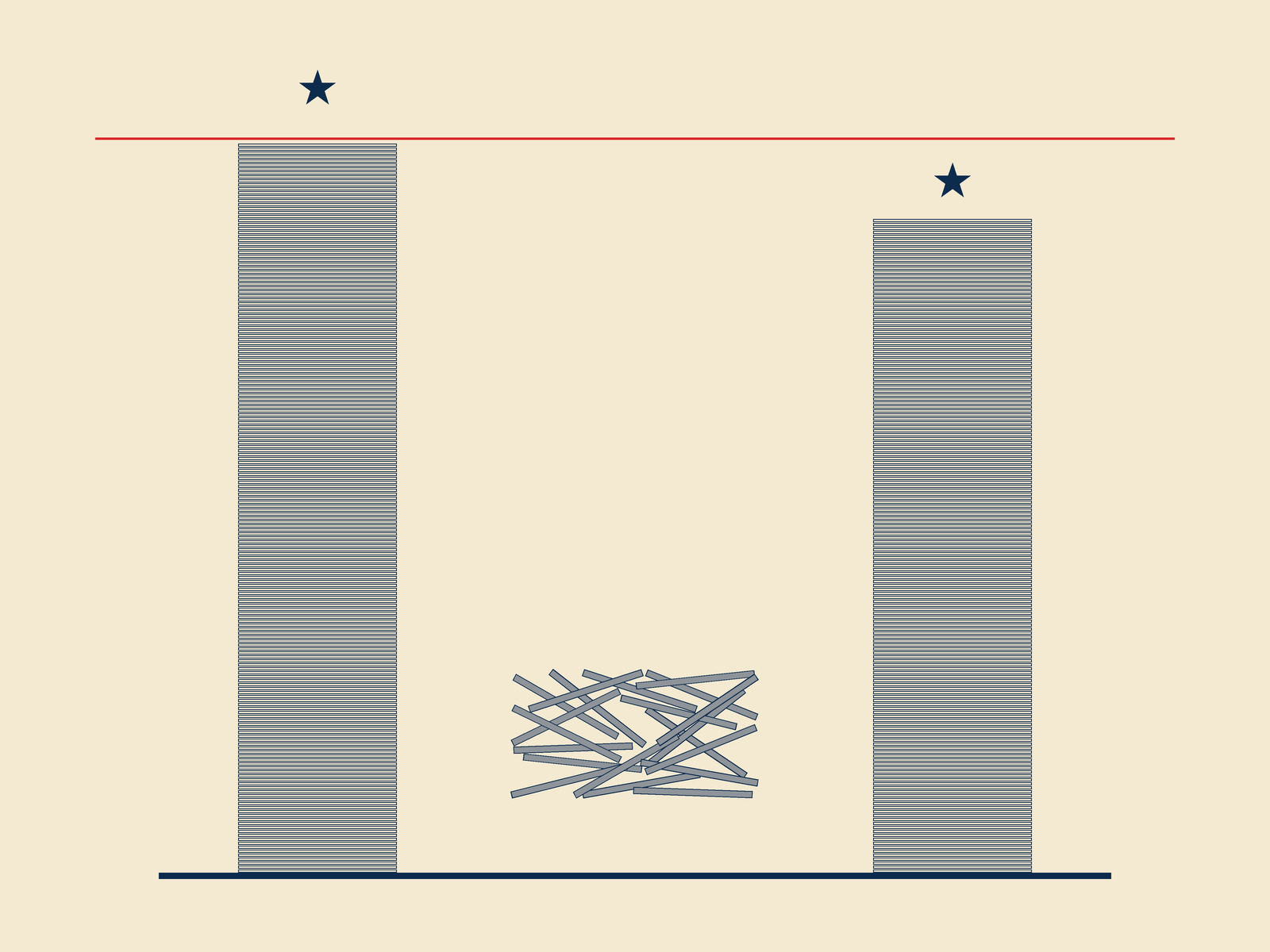
When the count of 1876 stopped, which seat would you rather have been sitting in?
Two Answers from One State
On election night both parties claimed the presidency. The fight came down to the three Southern states where Reconstruction governments still sat, and to one elector in Oregon.
Both parties used violence and threats in these states. Democrats used them to keep Black citizens from voting; Republicans used them to make sure Black citizens voted Republican. Both sides bought votes. So could point to real wrongs done by the other.
Oregon was a different case. Hayes had clearly won it. But one of his three electors, John W. Watts, had been a United States postmaster, and the Constitution says that no "person holding an office of trust or profit under the United States" may be an elector. Oregon's Democratic governor, La Fayette Grover, removed Watts and put a Tilden elector, C. A. Cronin, in his place. Republicans answered that Watts had resigned his post before the electors met.
On December 6, 1876, the electors met in every state. In four capitals, Tallahassee, New Orleans, Columbia and Salem, two sets of electors met, voted and sent their certificates to Washington.
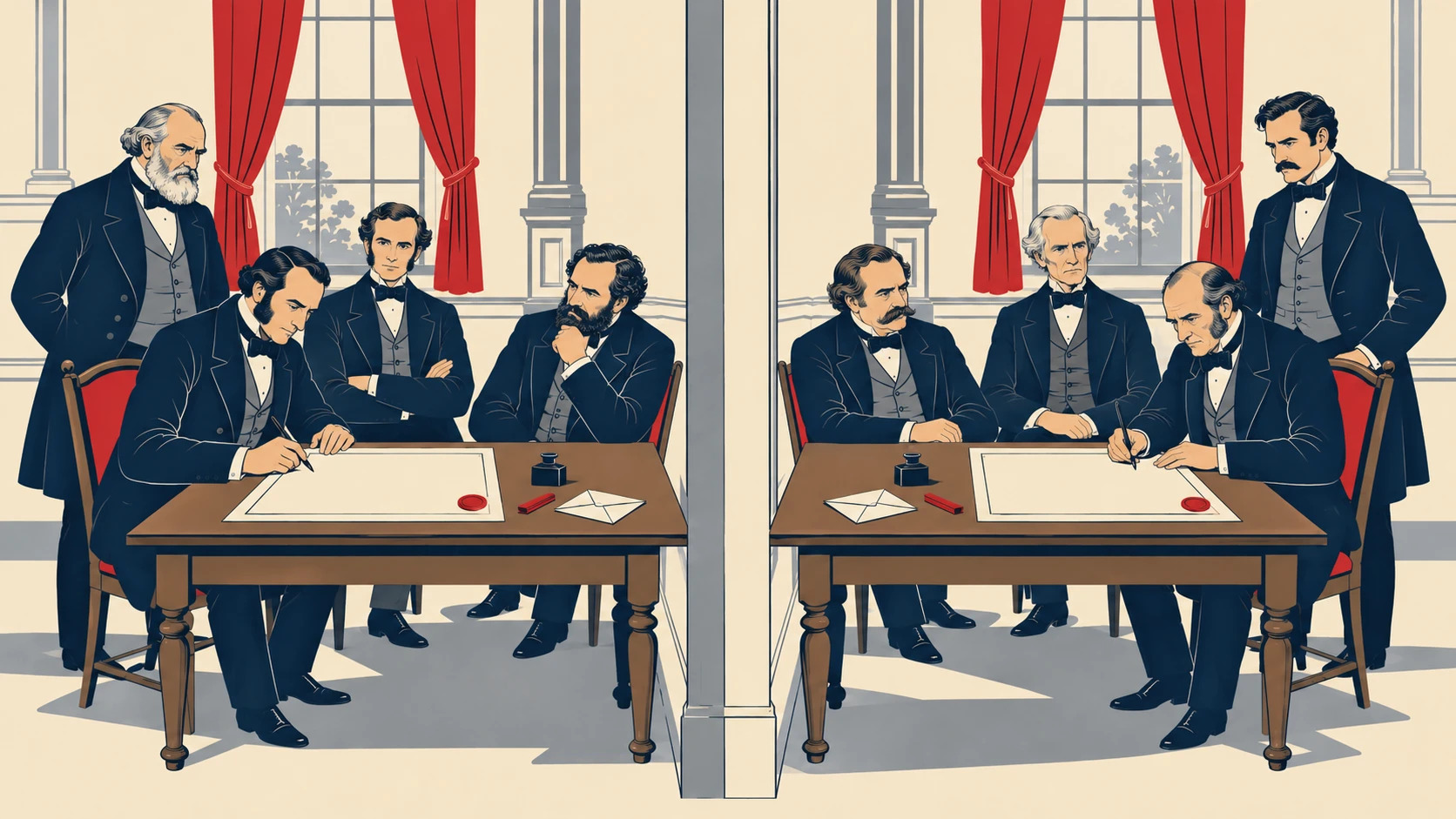
Eight to Seven
Here's where it tightens. The Constitution says the President of the Senate opens the certificates before both houses and the votes are then counted. It does not say who counts them, and it says nothing about a state that sends two sets. In 1876 the Senate had a Republican majority and the House a Democratic one.
In December each house named a committee to find a way through. Their answer was an Electoral Commission of 15 members, whose rulings would stand unless both houses voted to overrule them. The Senate passed the bill 47 to 17 on January 25, 1877, and the House passed it 191 to 86 the next day. Democrats in Congress voted for it 181 to 19; Republicans voted against it, 84 to 57. President Grant signed it on January 29.
On January 25 the Illinois legislature, where Democrats and Greenbacks voted together, elected Davis to the United States Senate, 101 to 99. Davis to serve on the commission. His place went to Justice Joseph P. Bradley, a Republican. The commission now stood 8 Republicans to 7 Democrats.
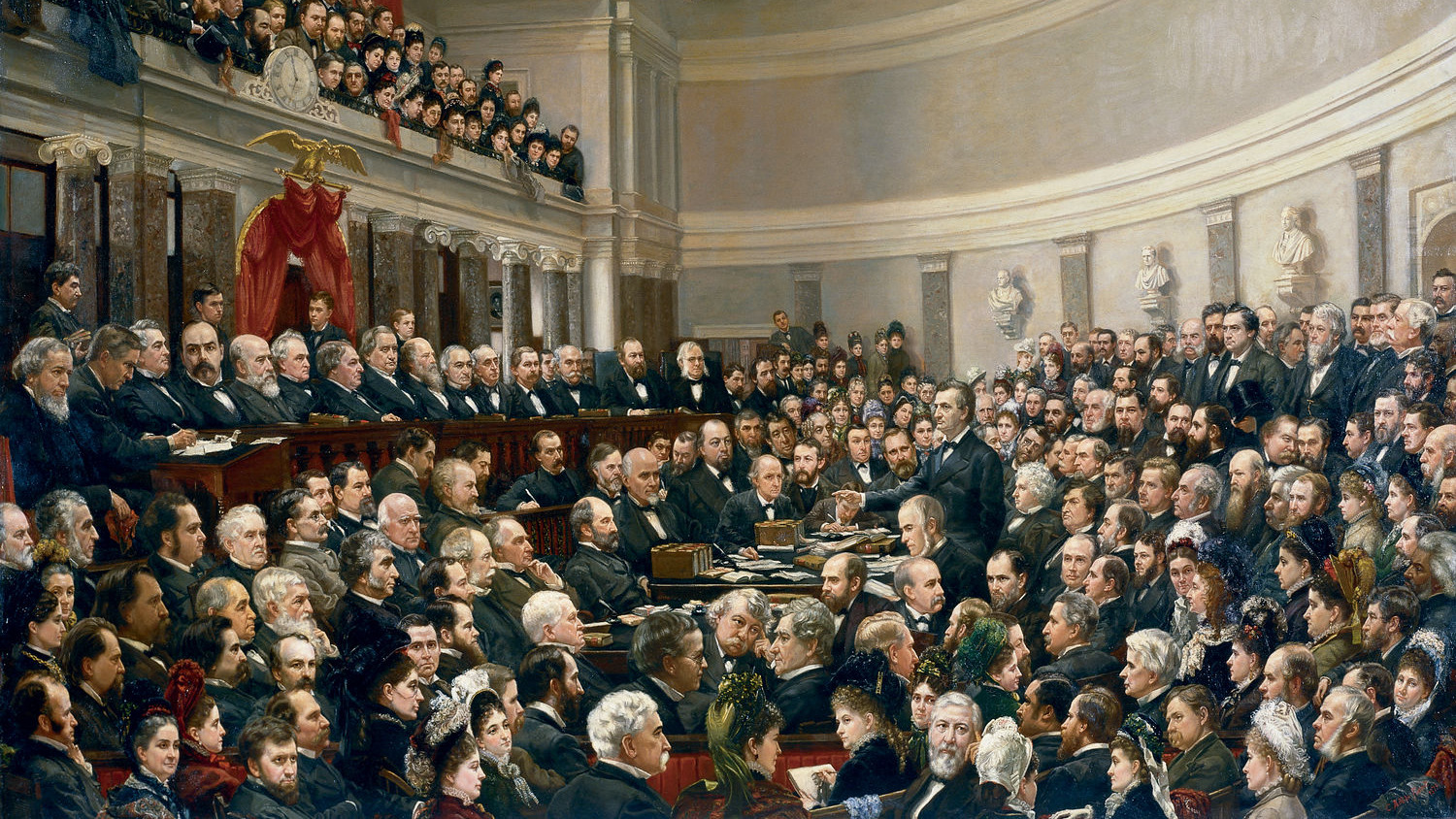
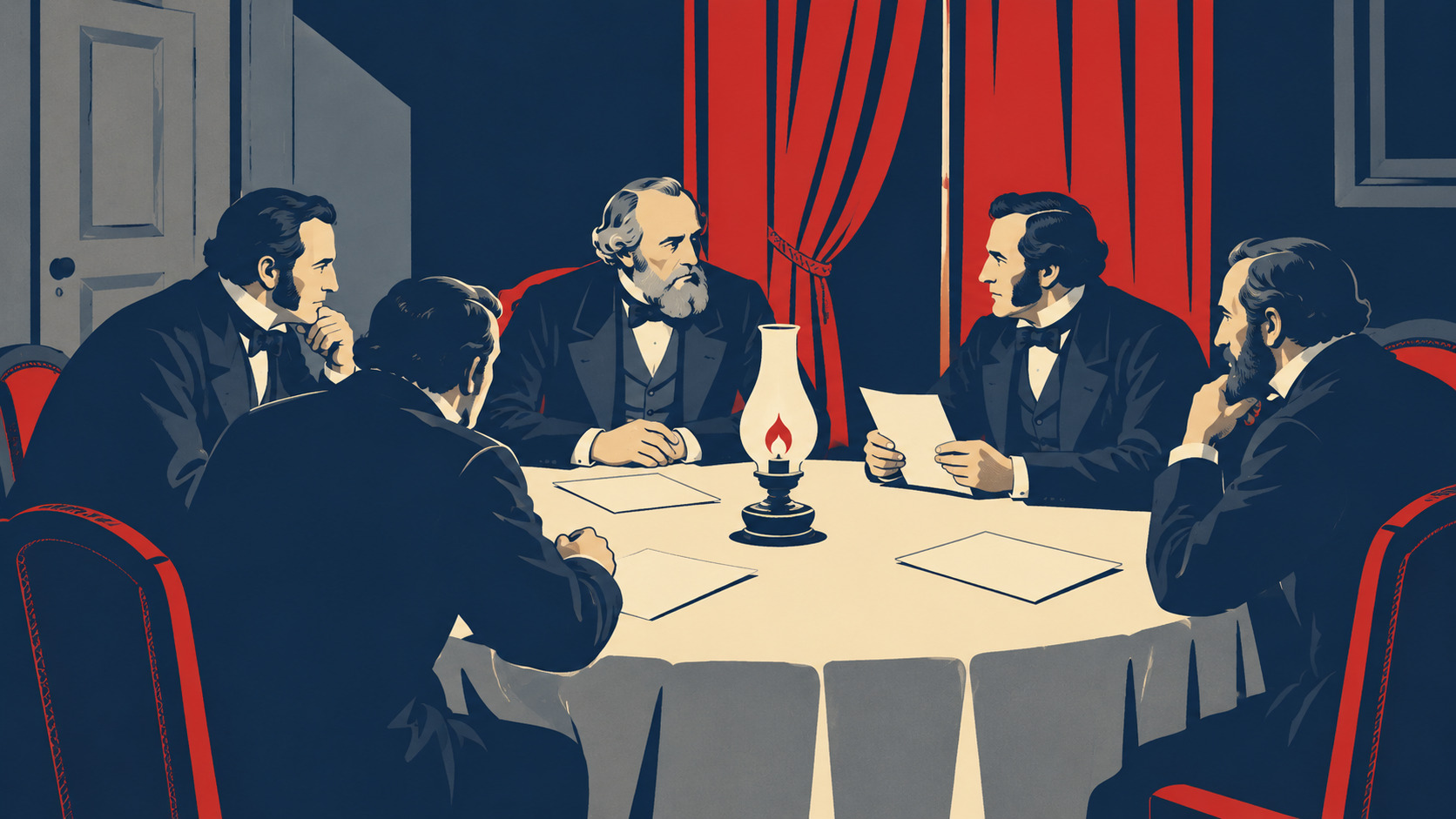
The commission met in the Supreme Court's chamber inside the Capitol and heard Florida first. Tilden's lawyers wanted to bring in more evidence about the returning boards. Hayes's lead lawyer, William Evarts, argued that the commission should weigh only the returns already before Congress. On February 8, by 8 to 7, the commission refused to hear more evidence. On February 9, by 8 to 7, it gave Florida to Hayes. February 9 was Samuel Tilden's sixty-third birthday.
The Bargain at Wormley's
The commission had ruled, but the joint session still had to finish the count before March 4. Some Democrats in the House used a filibuster: a way of delaying a vote by talking or stalling so it never comes to a decision. Angry voices called for "Tilden or Blood." Tilden himself such schemes and favored a formal challenge instead. President Grant feared an uprising by Tilden's supporters.
On the evening of February 26, 1877, Southern Democrats and Ohio Republicans who spoke for Hayes met at Wormley's Hotel, at 15th and H Streets in Washington. It was the last of a series of such meetings. The hotel's owner, James Wormley, was an African American born free in Washington; no evidence shows he took any part.
The terms: the federal troops guarding the statehouses in South Carolina and Louisiana would be withdrawn. Hayes insisted that the Democrats in those states pledge to uphold the civil and voting rights of Black and white Republicans. In return, the Southern Democrats would accept Hayes as president. These terms were never voted on or written into law. The deal is called the Compromise of 1877.
House members filibustered over Vermont and Wisconsin until the Democratic Speaker, Samuel J. Randall, ruled the filibusterers out of order. At 4:10 a.m. on March 2, 1877, the joint session declared Hayes elected, 185 to 184. The news reached Hayes on his way to Washington. March 4 fell on a Sunday, so he took the oath privately in the Red Room of the White House on Saturday, March 3, and publicly at the Capitol on Monday, March 5. In April the troops left the statehouses: in Columbia, South Carolina, on April 10, and in New Orleans on April 24.
The Moderation of a Settlement
The virtue in this lesson is moderation: holding your own claims and your own anger within limits, so that a dispute is settled by law and not by force. In the winter of 1877 the passions ran hot, and moderation was practiced, or abandoned, in public.
Tilden moderation. He believed he had been elected. He did not take an oath of his own, and he did not call his supporters into the streets. Speaker Randall, a Democrat, applied it too when he ended his own party's filibuster.
But every settlement has a cost, and someone pays it. Ask yourself who sat at the table at Wormley's Hotel, and who did not. Before the century ended, Southern state legislatures passed laws that took the vote from most Black citizens, mostly through poll taxes and literacy tests. In 1890 Mississippi adopted a new constitution with both. During Reconstruction more than 90 percent of Mississippi's Black men of voting age had been registered to vote; by 1892, fewer than 6 percent were.
Aristotle figured this out a long time ago. In his Ethics he wrote that virtue is "a mean between two vices, that which depends on excess and that which depends on defect." Too little moderation is refusing to bend at all. Too much is bending so far that you give away what was never yours to give.
Conclusion
Go back to February 1, 1877, and Florida's three certificates. Three states sent two answers, and Oregon sent a quarrel over one elector. A commission of 15 chose one answer every time, 8 to 7. A bargain at Wormley's Hotel cleared the way, and the count ended at 4:10 in the morning.
How the map changed. Hayes became president with 185 electoral votes to Tilden's 184, though Tilden won the popular vote, 4,300,590 to 4,036,298, a majority of 50.9 percent. That made 1876 one of five elections in which the winner of the popular vote did not become president. All 20 disputed votes, 4 from Florida, 8 from Louisiana, 7 from South Carolina and 1 from Oregon, went to Hayes. The troops left the last two guarded statehouses, and Reconstruction ended. Ten years later, Congress wrote a standing rule, the Electoral Count Act of 1887; in that debate Senator John J. Ingalls called the commission of 1877 "a contrivance that will never be repeated in our politics."
How the republic's character moved. In 1876 the Constitution had no rule for a state that sent two answers. The Americans of 1877 settled it with a commission and a bargain, before March 4, and without war. But the bargain also showed that a deal among leaders could decide what the voters never voted on, and the protection promised to Black citizens in the South did not hold. It was one election in the whole true history of the American vote. In the next lesson, the election of 1888, the popular vote and the Electoral College will part ways again, with no dispute at all.
To live well is to practice moderation: to hold your own claim within the rules, and to remember who is not at the table.
Because elections are won and lost.
Parties rise and fall.
But the republic rests on its citizens.
Lesson Summary
Key Terms
- Returning board
- a state board that received the counts, could throw out votes it judged fraudulent or cast under threat, and certified the official result.
- Electoral Commission
- the 15-member body Congress created in January 1877 to decide the disputed returns of 1876.
- Popular majority
- more than half of all popular votes cast; Tilden won 50.9 percent.
- Filibuster
- a way of delaying a vote by talking or stalling so it never comes to a decision.
- Compromise of 1877
- the unwritten bargain under which Southern Democrats accepted Hayes as president and the troops guarding two Southern statehouses were withdrawn.
- Reconstruction
- the period after the Civil War when the national government worked to rebuild the Southern states and bring them back into the Union.
- Mob
- from the Latin mobile vulgus, "the movable crowd": a crowd stirred to sudden action.
- Checks and balances
- a design in which each part of a government can stop or slow another, so sudden passions have somewhere to go.
- Greenback Party
- a party founded in 1874 by farmers and farm workers hurt by the Panic of 1873; it wanted more paper money.
Cause-and-Effect Chart
| Key Fact | The Cause | The Effect |
|---|---|---|
| 20 electoral votes were in dispute | Returning boards in three states threw out votes, and Oregon's governor replaced one elector | Neither candidate had 185 undisputed votes |
| Congress created a 15-member commission | The Constitution did not say who counts the votes or what to do with two sets | The commission decided which returns to count |
| Hayes won 185 to 184 | Justice Bradley replaced Justice Davis, and the commission voted 8 to 7 on every dispute | All 20 disputed votes went to Hayes |
| The troops left the statehouses in April 1877 | Southern Democrats accepted Hayes under the Compromise of 1877 | Reconstruction came to an end |
Timeline
| Person / Event | Date (AD) | Description |
|---|---|---|
| Election Day | November 7, 1876 | Tilden wins 4,300,590 popular votes to Hayes's 4,036,298; turnout 82.6 percent. |
| The electors meet | December 6, 1876 | Two sets of electors vote in Tallahassee, New Orleans, Columbia and Salem. |
| Electoral Commission Act | January 29, 1877 | President Grant signs the law creating the 15-member commission. |
| Florida ruling | February 9, 1877 | The commission votes 8 to 7 to give Florida to Hayes. |
| Wormley's Hotel meeting | February 26, 1877 | Southern Democrats and Hayes's Ohio supporters hold the last of the meetings behind the Compromise of 1877. |
| The count ends | March 2, 1877 | At 4:10 a.m. the joint session declares Hayes elected, 185 to 184. |
| Hayes's inauguration | March 3 and 5, 1877 | Private oath in the Red Room of the White House; public oath at the Capitol. |
| Troops leave the statehouses | April 10 and 24, 1877 | Columbia, South Carolina, then New Orleans; Reconstruction ends. |
COMMAND QUESTIONS
Factual Recall
The "Why" Questions
Write a short paragraph answering each question in your own words, in your notebook. Then check its box: +4 each.
Explain in two or three sentences why Hayes needed every one of the 20 disputed votes while Tilden needed only one.
Explain how Justice David Davis's election to the Senate changed the outcome of the Electoral Commission.
Cast Your Ballot
you are a citizen of 1876 — cast one vote for one ticket's electors in your state; the ticket that wins 185 of 369 electoral votes wins
Loading…
The ballot: 1876 — President (one vote for one ticket's electors)
Samuel J. Tilden and Thomas A. Hendricks — Democratic — reform: a sound currency, a tariff for revenue only, and an honest civil service
Rutherford B. Hayes and William A. Wheeler — Republican — the United States a nation, not a league, with every citizen protected in the free enjoyment of all his rights
Peter Cooper and Samuel F. Cary — Greenback — more paper money to raise farm prices, ease loans and lighten debts
What a voter knew on November 7, 1876:
- Hard times had gripped the country since the Panic of 1873.
- Federal troops were still stationed in South Carolina, Florida and Louisiana.
- Tilden had prosecuted the Tweed Ring; Hayes had been elected governor of Ohio three times.
- 185 of 369 electoral votes would be needed to win.
What the voters decided: Tilden won the popular vote, 4,300,590 (50.9 percent) to 4,036,298 (47.9 percent); after the commission, Hayes won the Electoral College, 185 to 184.
Cast your own ballot on MockElection.com — vote as a citizen of 1876, with only what a citizen of 1876 knew. Then compare your count to history.
Picture yourself in Congress in January 1877. A state has sent two sets of returns, and the Constitution does not say who decides. Whom would you trust to choose?
Two games wait below
Whistle-Stop
The lesson’s words, against the clock. Twelve in a row earns the Blue Ribbon.
The Canvass
Match each cause to its effect, then each event to its year. Both boards with one miss or fewer earns the Clean Count.
0 of 100 points
Kept in this browser for this visit. Sign in to keep it on any device.