
Lesson 6 — 1888: More Votes, Fewer Electors
Harrison, Cleveland, and the Map of Industry
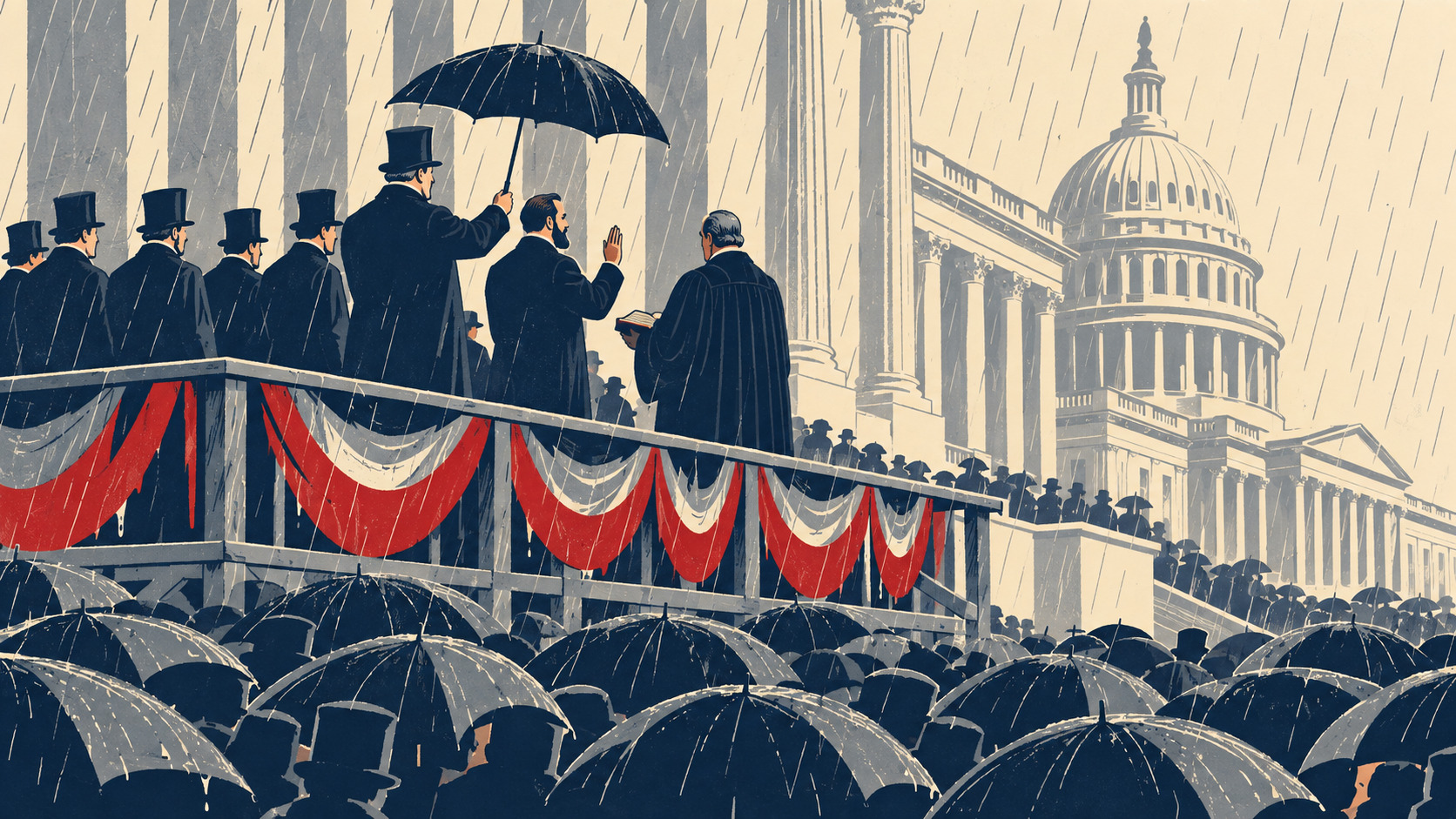
Picture the East Portico of the Capitol in Washington on March 4, 1889. A hard rain is falling. A new president, Benjamin Harrison, stands with his hand raised to take the oath of office. Beside him, holding an umbrella over the new president's head, stands the man he is replacing: President Grover Cleveland. Four months earlier, on November 6, 1888, Cleveland had won more votes than anyone else in the country — 5,534,488 to Harrison's 5,443,892. That is 90,596 more. But the presidency is decided by , and among the electors Cleveland had lost, 233 to 168. How can a president win the most votes in the country and still lose his job? Here is what was at stake. The two parties were fighting over trade and the growing factories of the North, and the answer would show, once again, how the Electoral College turns votes into power. At MockElection.com we want to make you a scholar of the republic. Let's see how a free people chose.
A Fight over Trade
In 1887, the government of the United States was taking in more money than it spent. Most of that money came from tariffs. A tariff is a tax on goods brought in from another country. The extra money that piles up when a government takes in more than it spends is called a surplus. On December 6, 1887, President Cleveland sent Congress his yearly message, and he gave the whole message to one subject: the . He reported that the surplus for the year was expected to reach $113,000,000 by June 30, 1888, which would swell the money held in the Treasury to $140,000,000.
The fight that followed was about trade policy: the rules a country sets for buying and selling goods with other countries. The biggest question was protectionism: using tariffs to protect a nation's own factories and workers from foreign competition. Should the tariff stay high to guard American industry? Or should it come down, so the government stopped taking more from the people than it needed?
The Democrats met at St. Louis on June 5–7, 1888. They named Cleveland again without a formal ballot. Cleveland was the incumbent: the person who already holds the office. For vice president they chose Allen G. Thurman of Ohio, a former senator, 74 years old, known across the country as "the Old Roman." The Republicans met in Chicago from June 19 to June 25. Seven serious candidates sought the nomination. Benjamin Harrison, a former senator from Indiana, became everyone's second choice and won on the eighth ballot, 544 votes to 108. His running mate was Levi P. Morton, a New York banker.
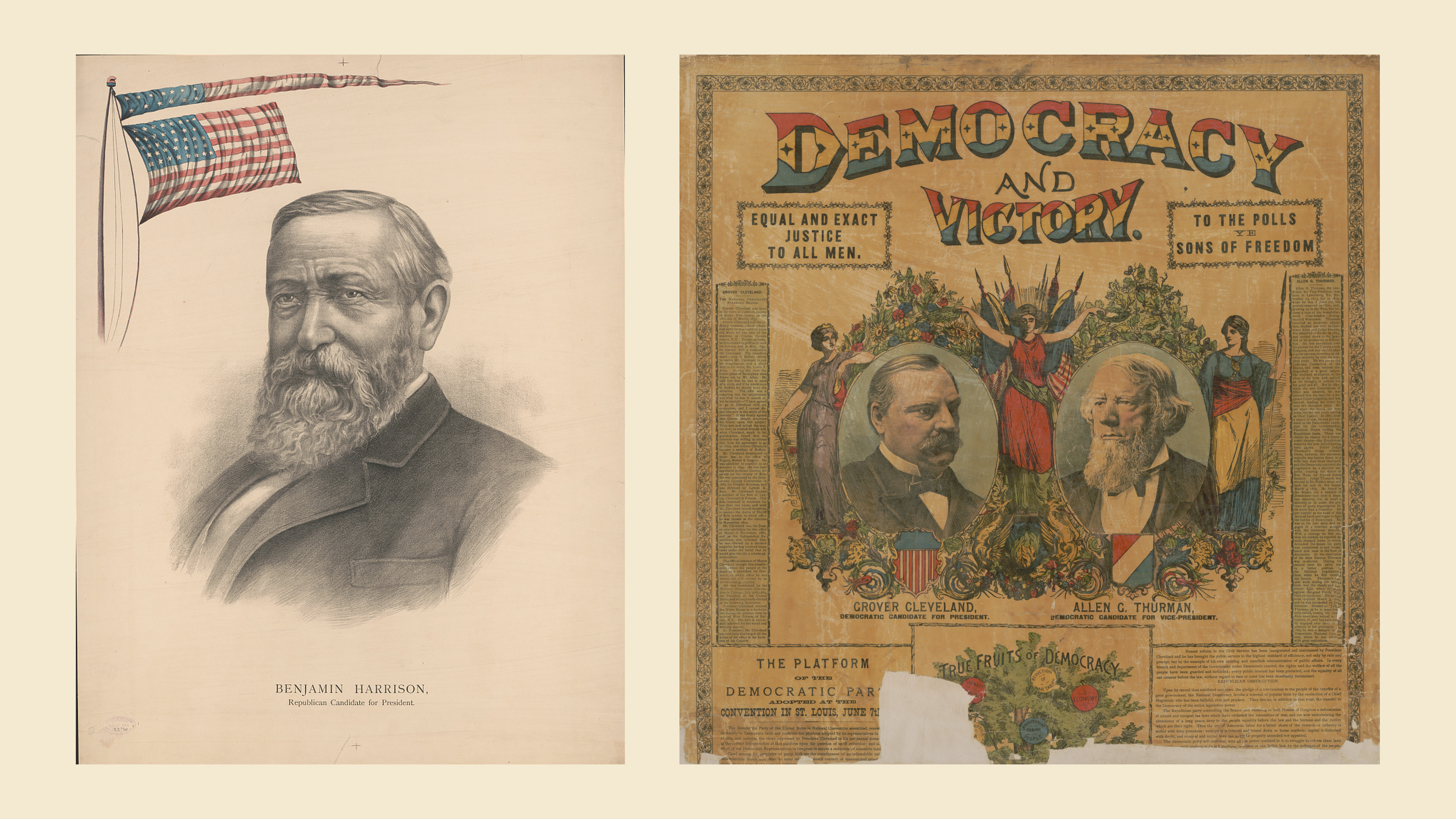
You just heard both sides of the tariff fight. If you were voting in 1888, which plan would you back?
Two Candidates Who Stayed Home
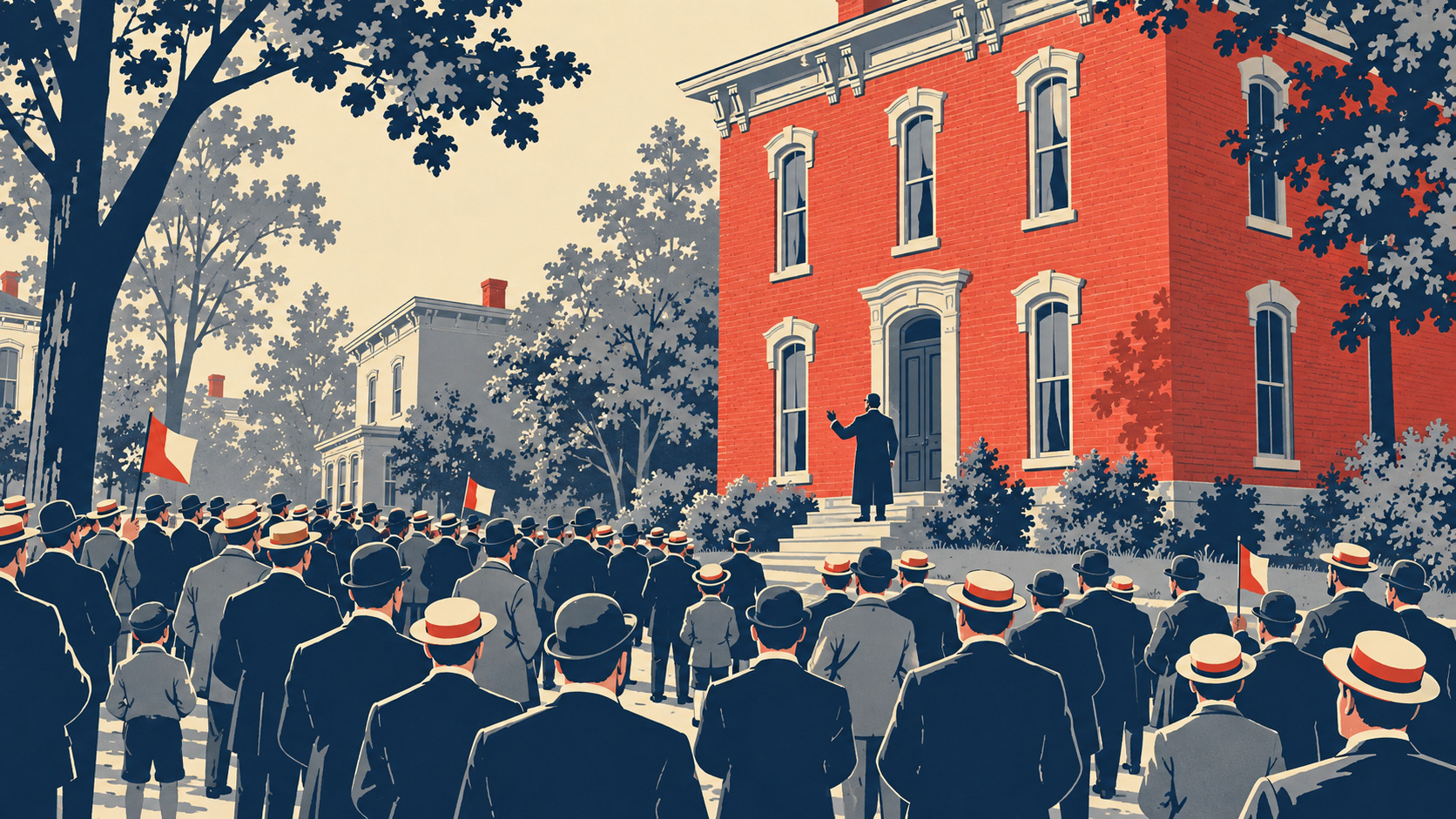
Harrison found a way to campaign without leaving Indianapolis. He did not travel to the voters. The voters to him, at his house on North Delaware Street. Delegations rode the trains into the city, and hundreds of men at a time spilled out of Union Station and marched north to his lawn. Harrison stood on a step below his front door and gave each group a short speech. Reporters he invited sent his words to newspapers across the country. Over the campaign he gave more than 80 speeches to more than 300,000 people.
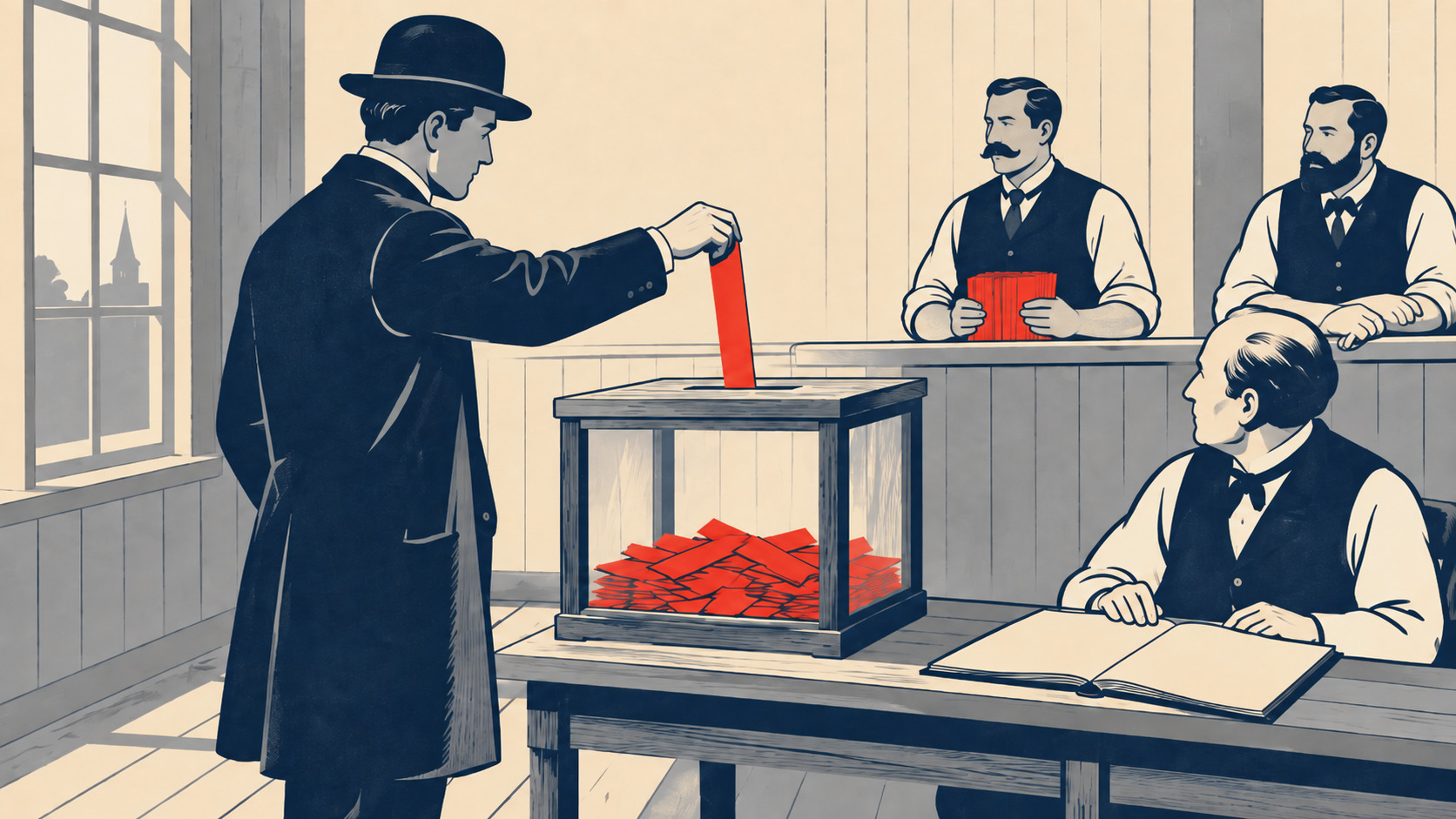
That system made one letter possible. On October 24, 1888, William W. Dudley, the treasurer of the Republican National Committee, sent a circular letter to Republican leaders in Indiana. It told them to "divide the floaters into blocks of five, and put a trusted man with necessary funds in charge." A floater was a voter who would sell his vote. A railway postal clerk in Indiana intercepted a copy, it reached the Democrats, and they spread it across the country in the last days of the campaign. Dudley called the letter a forgery and sued the newspapers that printed it.
Where the Votes Were
Americans voted on Tuesday, November 6, 1888. Under the Electoral Count Act that Congress had passed in 1887, the electors met in their own states on the second Monday in January: January 14, 1889. Congress counted their votes on February 13, 1889. Here is the count of 1888.
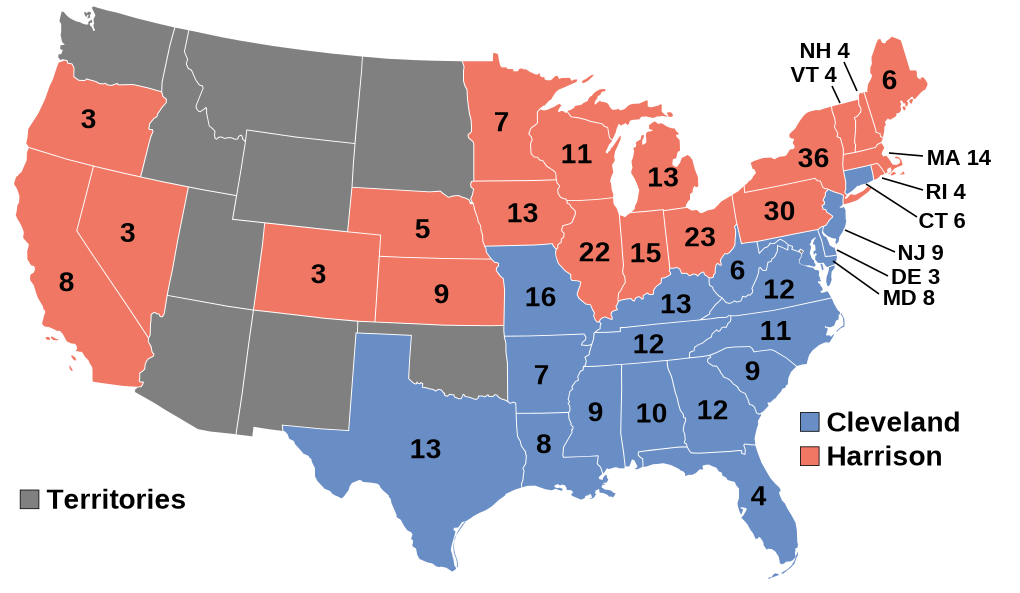
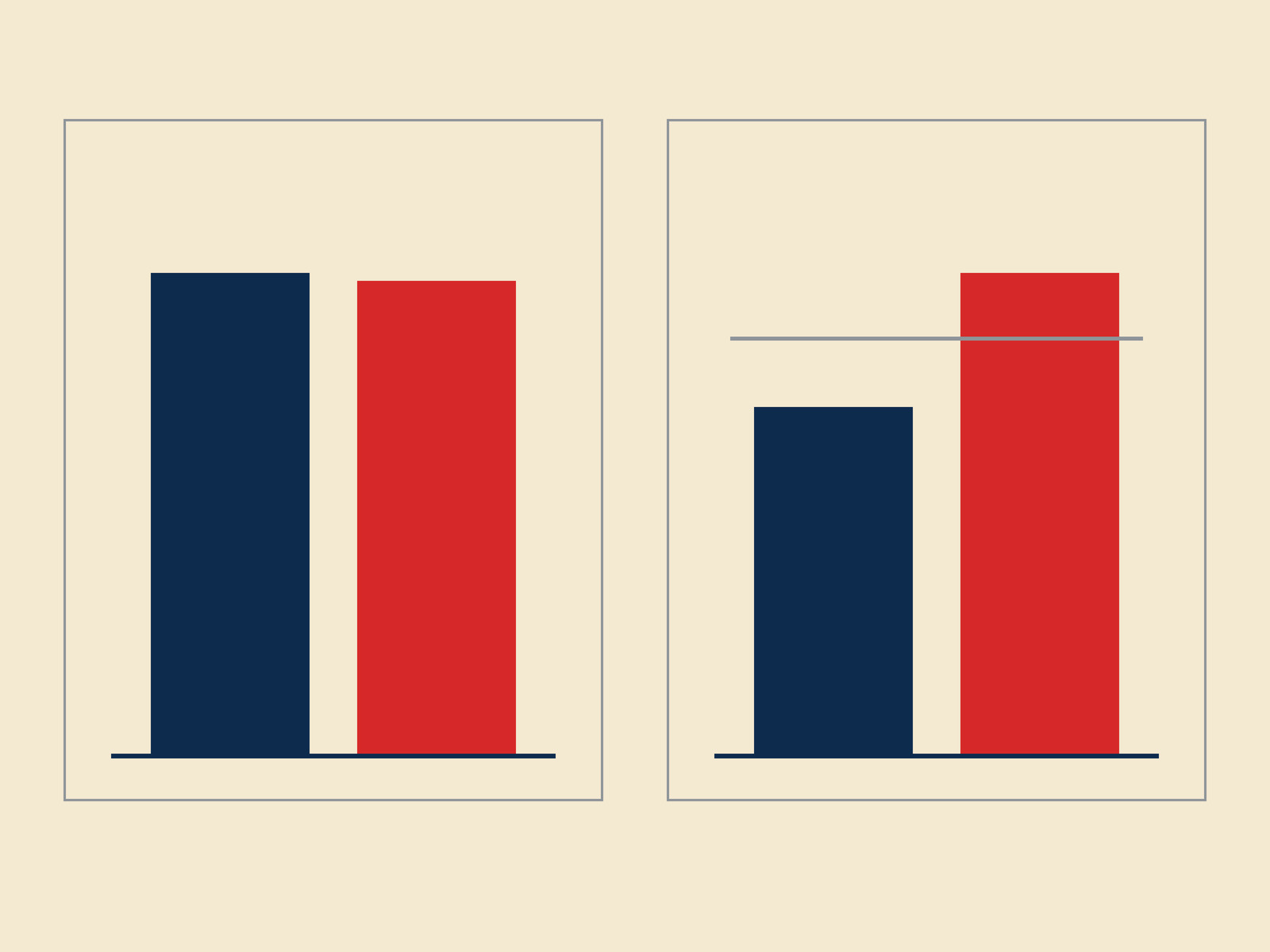
Cleveland won a plurality of the popular vote: more than anyone else, but not more than half. His lead was 90,596 votes, and much of it came from very large margins in the Southern states. Harrison's campaign went after a different prize. It aimed at the crowded, industrial states of the North. Crowded states have more Representatives, so they have more electors. Harrison carried almost the entire North and Midwest.
Five Times in History
As you recall, this had happened before. In 1824, Andrew Jackson led the popular vote and lost the presidency in the House. In 1876, Samuel J. Tilden won a popular majority and lost by one electoral vote after the Electoral Commission. Congress wrote the Electoral Count Act of 1887 after that dispute, and the votes of 1888 were the first presidential count under it.
But 1888 was different from both. There was no House vote, as in 1824. There was no dispute over the returns, as in 1876. The Electoral College simply worked the way it was built. The count was , and the popular vote and the electoral vote still pointed in different directions.
The Diligence of a Front-Lawn Campaign
The virtue in this lesson is diligence. Diligence is steady, careful work aimed at a goal. It means putting your effort where it counts, and keeping at it day after day.
Harrison and his campaign practiced diligence. Harrison stood on his steps through the summer and fall of 1888 and spoke to group after group, more than 80 times. His campaign studied the map. It knew the presidency is won one state at a time, so it put its effort into the crowded industrial states of the , where the electors were. It won New York and Indiana by narrow margins, and those narrow wins decided the election. Cleveland's large Southern margins were real votes from real citizens. But under the rules both men accepted, extra votes in a state already won could not change the outcome.
Aristotle figured this out a long time ago. He taught that we become good at things by doing them over and over. We become just by doing just acts. We become brave by doing brave acts. A habit of steady, aimed work is how a skill is built. He also taught that every virtue can be pushed too far. Here's where it tightens. The blocks-of-five letter, which Dudley called a forgery, put that danger in front of every voter in Indiana: work toward a goal so hard that honesty stops mattering.
And on March 4, 1889, Cleveland stood in the rain and held an umbrella over the man who had beaten him. The rules had worked as written, and both men stood by them.
Conclusion
Go back to the East Portico in the rain. Cleveland had 90,596 more votes than the man under his umbrella. He lost his home state by 14,373 votes, and he lost the presidency, 233 electoral votes to 168.
How the map changed. Harrison carried 20 states and Cleveland 18. Harrison won 233 of the 401 electoral votes, 32 more than the 201 he needed. Cleveland won 48.63 percent of the popular vote to Harrison's 47.80 percent. The Prohibition Party's 249,819 votes and the Union Labor Party's 146,602 votes won no electors. The election made 1888 the third time the national popular vote winner did not become president. The ballot itself changed, too. In 1889 alone, nine states adopted the secret ballot, and Indiana was one of them.
How the republic's character moved. In 1888, a sitting president lost under rules that worked exactly as written, and he held the umbrella anyway. The Americans had chosen again to pick a president through their states, not through one great national count. They also began to decide that a citizen's vote should be marked in private, where no party worker could watch it and no block of five could be checked. It was one election in the whole true history of the American vote. In the next lesson, the election of 1936, the two counts will agree. The margin will be one of the most decisive in modern two-party history. And a famous prediction will be proved wrong.
To live well is to practice diligence — to know where your effort counts, and to keep working there honestly.
Because elections are won and lost.
Parties rise and fall.
But the republic rests on its citizens.
Lesson Summary
Key Terms
- Tariff
- a tax on goods brought in from another country.
- Surplus
- the extra money that piles up when a government takes in more than it spends.
- Trade policy
- the rules a country sets for buying and selling goods with other countries.
- Protectionism
- using tariffs to protect a nation's own factories and workers from foreign competition.
- Incumbent
- the person who already holds an office.
- Party ticket
- a paper ballot printed by one party, listing only that party's candidates.
- Secret ballot
- a ballot printed by the government, listing every candidate, and marked in private.
- Plurality
- more votes than any other candidate, but not more than half.
- Winner take all
- the rule under which the candidate who wins a state wins all of its electors.
- Unit voting
- votes counted by groups, each group casting one vote decided by the majority inside it, as in Rome's 35 tribes.
Cause-and-Effect Chart
| Key Fact | The Cause | The Effect |
|---|---|---|
| The tariff became the issue of 1888 | Cleveland gave his whole message of December 6, 1887 to cutting it | Both parties' platforms made the election a vote on protection |
| Cleveland led the popular vote by 90,596 | Large margins in the Southern states | He won the most votes nationwide |
| Harrison won 233 electoral votes | His campaign targeted the crowded industrial North and won New York and Indiana narrowly | He won the presidency with fewer popular votes |
| Extra Southern votes added no electors | Winner take all gives the same electors for any margin | Cleveland's national lead did not decide the election |
| Nine states adopted the secret ballot in 1889 | Party tickets let workers watch votes, and the blocks-of-five letter became a national scandal | Indiana and others moved to government-printed ballots marked in private |
Timeline
| Person / Event | Date (AD) | Description |
|---|---|---|
| Prohibition Party founded | 1869 | A single-issue party for a legal ban on alcohol. |
| Electoral Count Act passed | 1887 | Sets the calendar for electors' votes and their count in Congress. |
| Cleveland's tariff message | December 6, 1887 | The president gives his whole yearly message to cutting the tariff. |
| Harrison nominated | June 25, 1888 | The Republicans choose Harrison on the eighth ballot in Chicago. |
| Election of 1888 | November 6, 1888 | Cleveland leads the popular vote by 90,596; Harrison carries New York and Indiana. |
| The electors vote | January 14, 1889 | Electors meet in their states: Harrison 233, Cleveland 168. |
| Congress counts the votes | February 13, 1889 | The count confirms Harrison's election. |
| Harrison takes office | March 4, 1889 | Sworn in at the East Portico in the rain, with Cleveland holding the umbrella. |
COMMAND QUESTIONS
Factual Recall
The "Why" Questions
Write a short paragraph answering each question in your own words, in your notebook. Then check its box: +4 each.
Explain in two or three sentences why Cleveland's large margins in the Southern states did not help him win the Electoral College.
How was the election of 1888 different from the elections of 1824 and 1876, even though in all three the popular vote winner did not become president?
Cast Your Ballot
you are a voter of November 6, 1888 — take one party's printed ticket and cast it for that party's whole slate of electors; every elector in your state goes to the ticket with the most votes in your state
Loading…
The ballot: 1888 — President (one party ticket per voter; each state's electors all go to the ticket that wins that state)
Grover Cleveland and Allen G. Thurman — Democratic — reduce the tariff and taxes generally, ending what it called unnecessary taxation, with care for American labor and manufacturers; stand on the record of the Cleveland administration.
Benjamin Harrison and Levi P. Morton — Republican — keep the American system of protection for home industries and their workers; repeal internal taxes before giving up any part of protection.
Clinton B. Fisk and John A. Brooks — Prohibition — a legal ban on alcoholic drinks, civil service reform, and direct voting procedures.
Alson Streeter and Charles E. Cunningham — Union Labor — more money in circulation, government ownership of transportation lines, and protections for workers.
What a voter knew on November 6, 1888:
- Grover Cleveland was the sitting president; New York was his home state, and Indiana was Harrison's.
- The election turned on the tariff, ever since Cleveland's message of December 6, 1887.
- About two weeks earlier, a letter from Britain's top diplomat favoring Cleveland had been published.
- In the last days of the campaign, the blocks-of-five letter had been printed, and Dudley had called it a forgery.
What the voters decided: Cleveland won the popular vote, 5,534,488 (48.63 percent) to 5,443,892 (47.80 percent); Harrison won the Electoral College, 233 to 168.
Cast your own ballot on MockElection.com — vote as a citizen of 1888, with only what a citizen of 1888 knew. Then compare your count to history.
Picture yourself in New York or Indiana in the fall of 1888. Which virtue did that election need most?
Two games wait below
Whistle-Stop
The lesson’s words, against the clock. Twelve in a row earns the Blue Ribbon.
The Canvass
Match each cause to its effect, then each event to its year. Both boards with one miss or fewer earns the Clean Count.
0 of 100 points
Kept in this browser for this visit. Sign in to keep it on any device.