
Lesson 7 — 1936: The Poll That Got It Wrong
Ten Million Postcards, One Landslide
Picture a long table piled with postcards. Each one is a sample ballot, mailed back to a famous magazine in New York, the Literary Digest. Ten million of these cards went out in 1936. 2.4 million came back. On October 31, 1936, the magazine printed its count: Alf Landon, 1,293,669; Franklin D. Roosevelt, 972,897. It predicted that would win 57 percent of the vote and Roosevelt 43. Three days later the real voters spoke. Roosevelt won 46 of 48 states. Landon won 2. How could 2.4 million answers be so wrong? Here is what was at stake. The country was in the Great Depression, and the voters were deciding whether to keep the president who had led them through it. And the way Americans measured what the people think was about to change for good. At MockElection.com we want to make you a scholar of the republic. Let's see how a free people chose.
Two Conventions in a Hard Year
In 1936 the United States was in the Great Depression, a time of hard economic trouble across the whole country. The president was Franklin D. Roosevelt, a Democrat. He was the incumbent, the man already in office. His government had created programs called the New Deal, which were meant to help Americans through the hard times.
The Republicans met in Cleveland, Ohio, from June 9 to June 12, 1936. They nominated Alf Landon, the governor of Kansas, for president. For vice president they chose Colonel Frank Knox, a newspaper publisher from Illinois. Their platform opened with four words: "America is in peril."
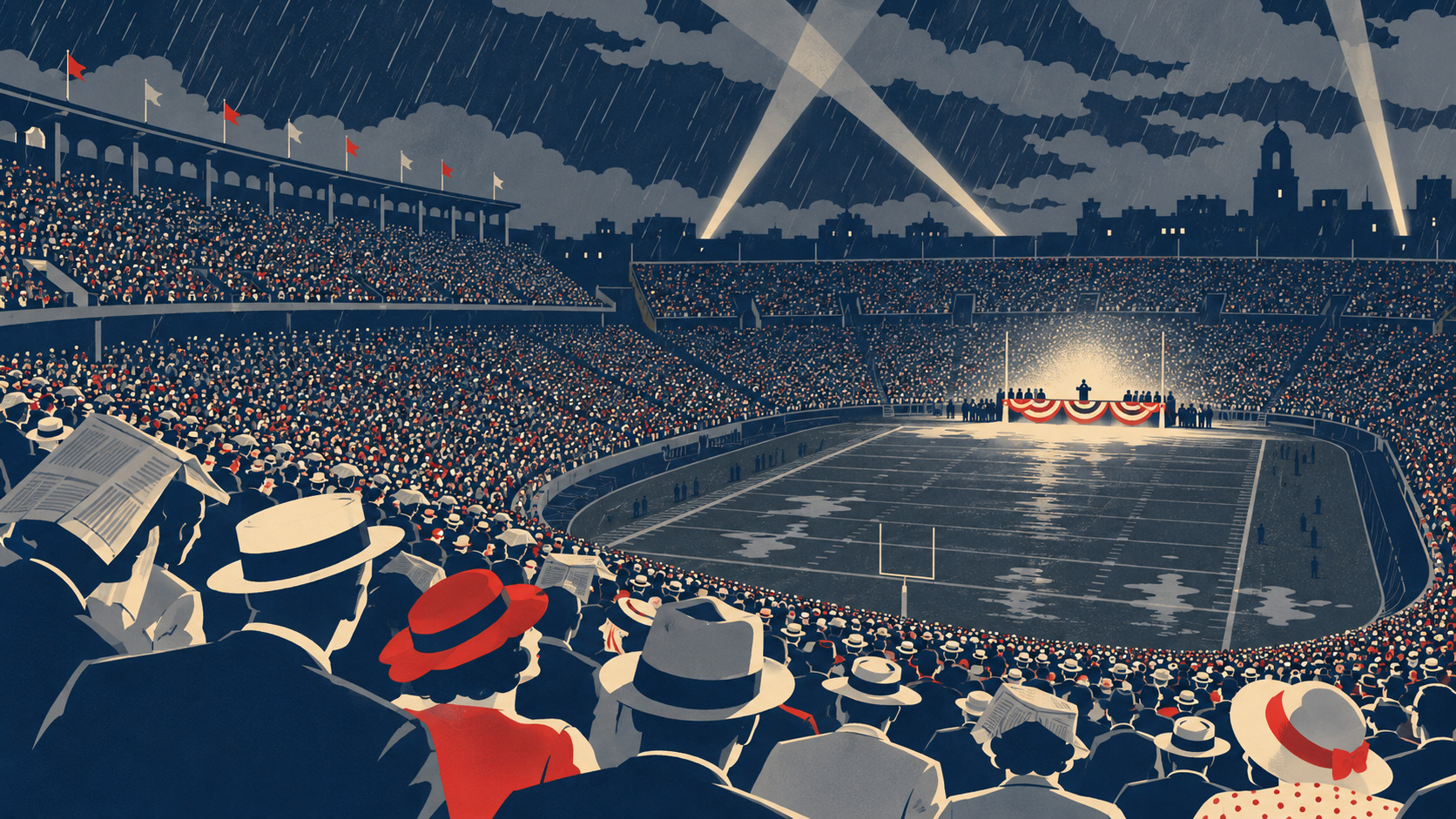
The Democrats met in Philadelphia from June 23 to June 27. They named Roosevelt and Vice President John Nance Garner again. On the night of June 27, Roosevelt came to Franklin Field, a college football stadium, to accept. More than 100,000 people filled it after a day of scattered summer rain, and thousands more waited outside. Roosevelt's legs had been paralyzed by polio, and he walked with steel braces. On his way to the platform, one brace snapped out of position. The pages of his speech scattered. His aides got him upright, and he went on to speak.
Three smaller parties also ran.
In 1936 many ballots carried five tickets: two large parties and three small ones. Which would you rather find on your ballot?
Ten Million Postcards
The Literary Digest was a national weekly magazine, first printed on March 1, 1890. In every presidential year since 1916 it had mailed sample ballots to voters across the country. It had called the winner five times in a row: 1916, 1920, 1924, 1928 and 1932. Newspapers printed its returns, and readers loved them. Each ballot also came with a subscription blank, so the poll sold the magazine too. Its method was a straw poll: an unofficial vote to measure what people think.
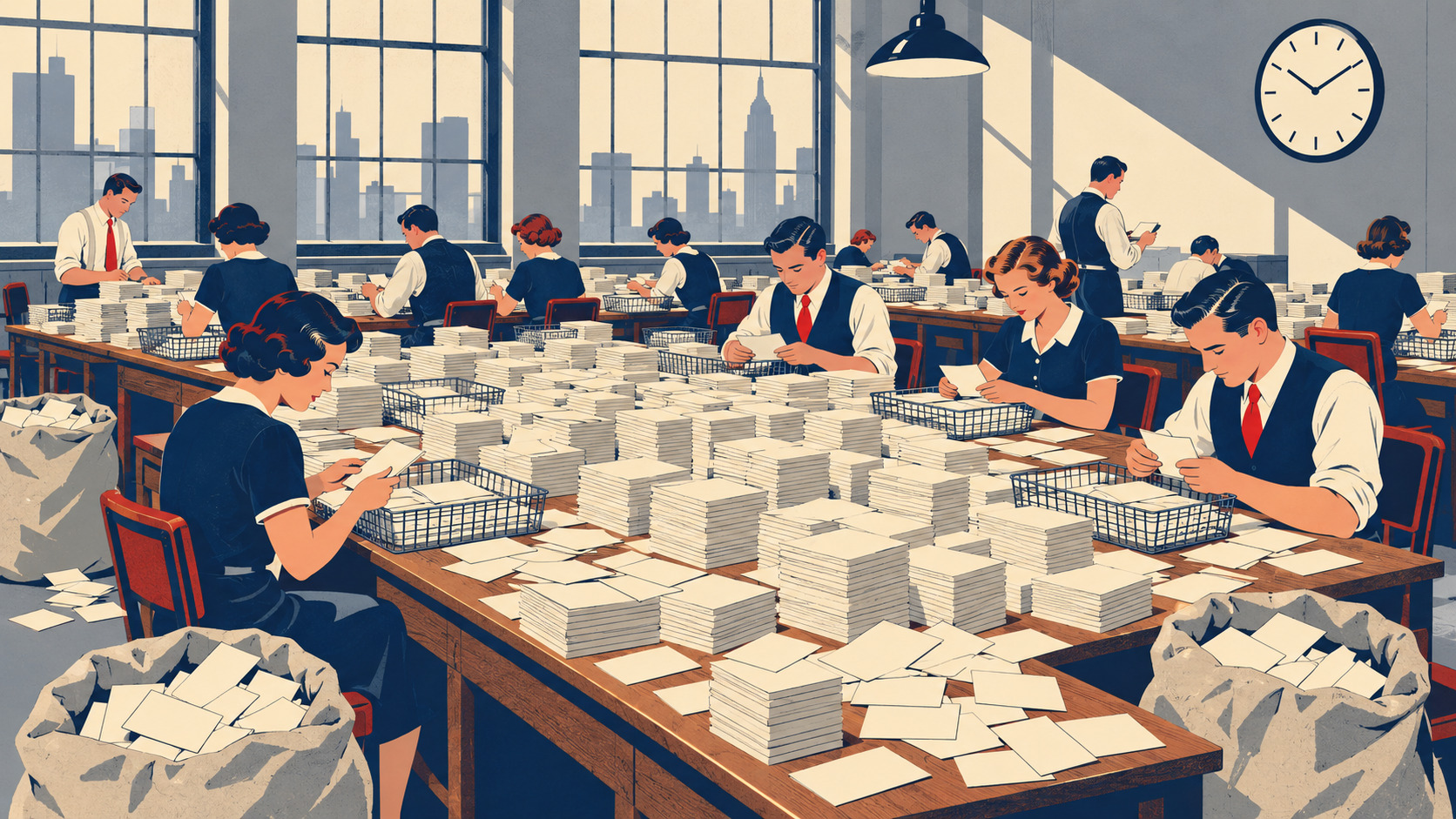
Feel the weight of that for a second. 2.4 million answers. It seemed impossible that so many answers could be wrong.
Where did the Digest get its ten million names? From three kinds of lists:
- telephone directories,
- motor vehicle registration records (lists of people who owned cars),
- club membership rosters.
Now take out the fact you kept in your pocket.
Not everyone trusted the giant pile. In 1935 a former journalism teacher named George Gallup had started the American Institute of Public Opinion. In 1936 he asked only about 50,000 people, chosen so that the group matched the country. He predicted Roosevelt would win 55.7 percent of the vote and 481 electoral votes. He even predicted that the Digest's own poll would show Landon ahead. And Roosevelt's campaign manager, James A. Farley, wrote the president a note: "I am still definitely of the opinion that you will carry every state but two, Maine and Vermont."
523 to 8
On Tuesday, November 3, 1936, Americans voted. To win, a ticket needed 266 of the 531 electoral votes. Here was the count.
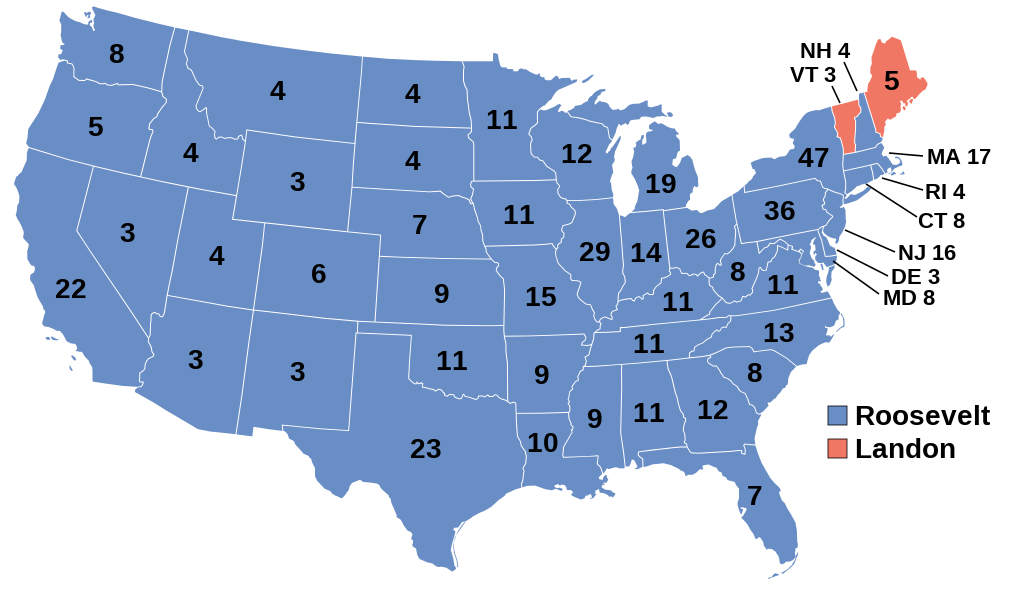
Landon won only Maine and Vermont. Roosevelt won a landslide, a victory by a very wide margin.
As you recall from the election of 1888, the count of the people and the count of the electors do not always point the same way. In 1936 a different pair of counts split apart: the count of the poll and the count of the voters. So what went wrong? Two kinds of error.
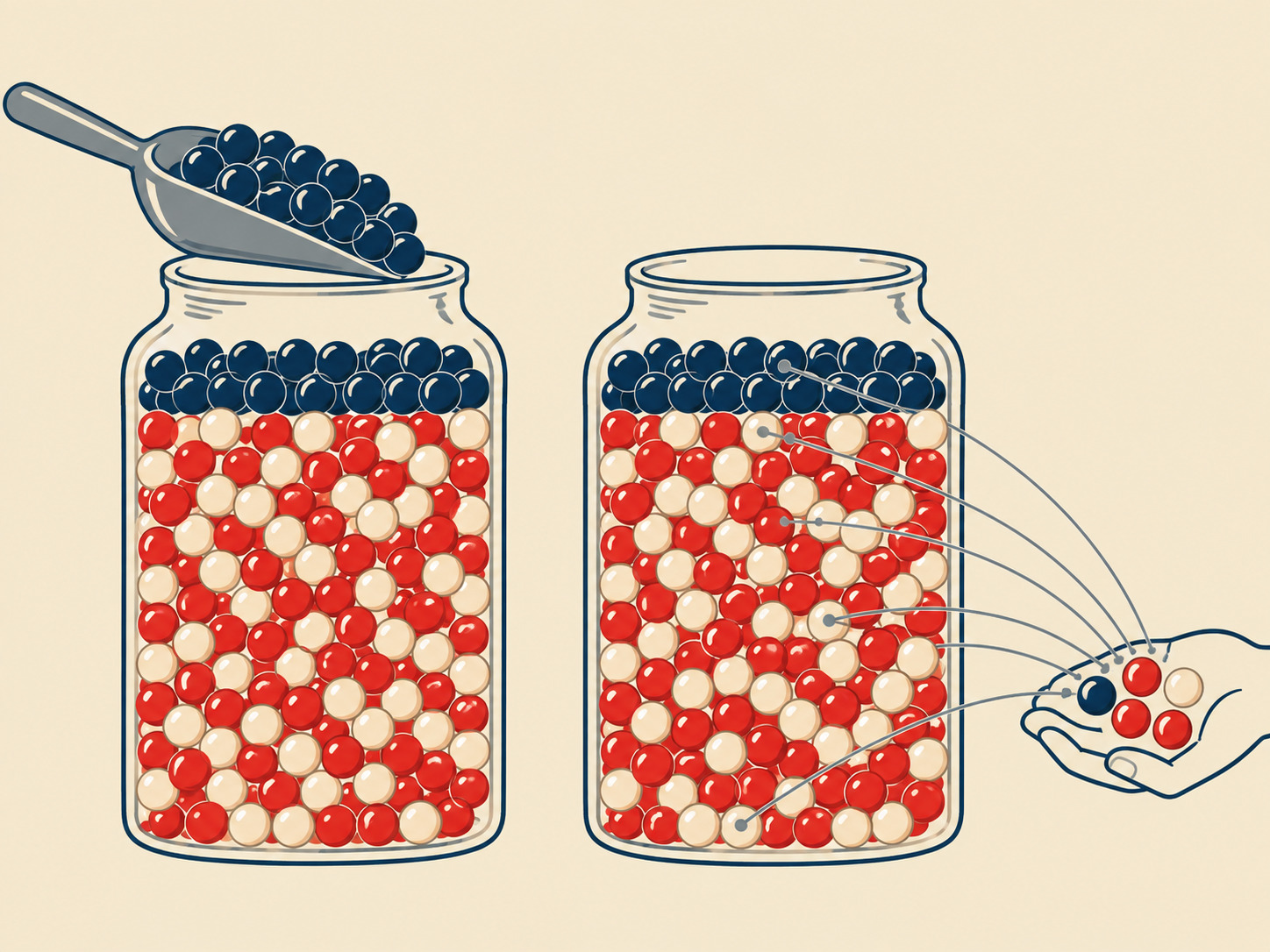
The first is selection bias. Who owned a telephone or a car in 1936, in the middle of the Depression? People with more money than most. And those wealthier citizens leaned heavily . The Digest's list was full of them. It left out many low-income citizens, city workers, and farmers. Many of those people had been helped by New Deal programs, and they voted in great numbers for Roosevelt.
The second is non-response bias. Only 2.4 million of 10 million people mailed their postcards back. The people who chose to answer were not a true copy of the people who did not.
The Humility of a Good Question
The virtue in this lesson is humility. Humility is knowing the limits of what you know. It is being willing to ask, "What if I am wrong?"
The Literary Digest had been right five times in a row. It had 2.4 million answers. It even wrote that it knew "the limitations of every straw vote." But it never acted on those words. It never asked the humble question: does our list look like the whole country? It trusted the size of its sample instead of checking who was in it.
Others practiced the virtue the Digest only wrote about. Gallup applied humility when he built a sample to look like the country instead of trusting a big one. Landon applied it in defeat, when he wired the man who beat him, "The Nation has spoken."
The poll's failure changed how Americans study public opinion. After 1936, survey research moved away from collecting the biggest pile of answers. It moved toward probability sampling: choosing people by chance, in a planned way, so that the sample is a true copy of the whole population. The Digest itself did not last. It stopped printing on February 24, 1938, and in May 1938 Time magazine took it over, 48 years after its first issue.
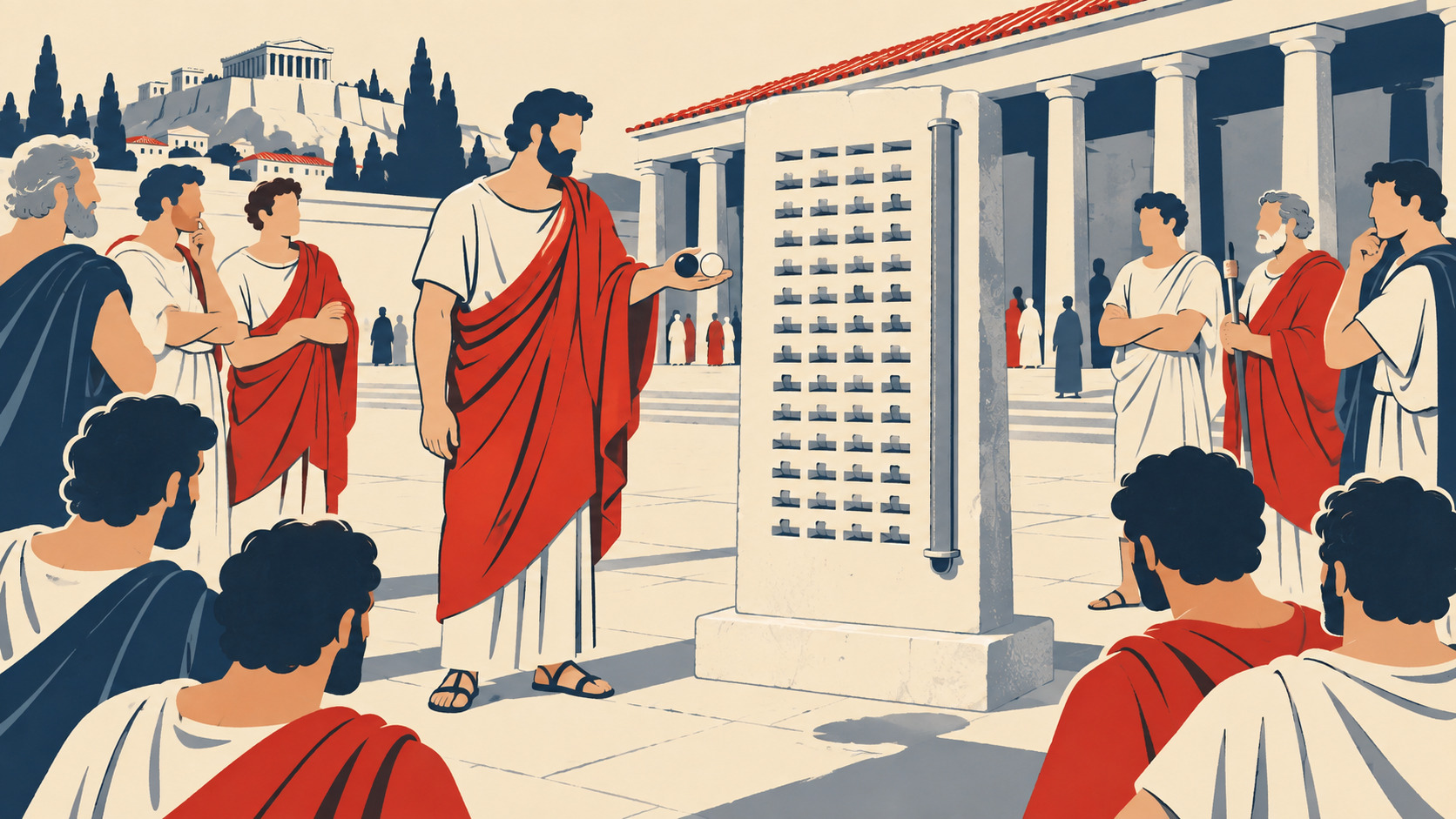
Socrates figured this out a long time ago. In Athens in 399 BC, he stood on trial for his life. He said he was wiser than others in only one way: he did not think he knew what he did not know.
Conclusion
Go back to those tables of postcards. Ten million went out, and 2.4 million came back. They pointed to Landon. The voters pointed to Roosevelt, 523 electoral votes to 8. On January 20, 1937, Roosevelt took the oath on the East Portico of the Capitol in cold rain. It was the first inauguration ever held on January 20, the new date set by the Twentieth Amendment.
How the map changed. Roosevelt carried 46 of 48 states and 523 of 531 electoral votes, 98.49 percent. He won 27,752,648 popular votes, 60.80 percent, to Landon's 16,681,862, 36.54 percent. Landon carried only Maine and Vermont. The Union, Socialist, and Communist parties together won 1,159,603 votes and no electors. In the world of polling, the old method of mailing out a giant pile of ballots gave way to scientific sampling. The magazine that ran the biggest pile was gone within two years.
How the republic's character moved. In 1936 the whole people's choice proved a famous magazine wrong. The voters the lists left out, low-income citizens, city workers, and farmers, voted in great numbers for Roosevelt. The lesson stayed: you cannot learn what the whole people think by asking only some of them. It was one election in the whole true history of the American vote. Forty-eight years later, in 1984, a candidate would win 525 electoral votes, the highest total in United States history, two more than Roosevelt's 523.
To live well is to practice humility: to ask "what if I am wrong?" before the whole country answers for you.
Because elections are won and lost.
Parties rise and fall.
But the republic rests on its citizens.
Lesson Summary
Key Terms
- Incumbent
- the person already holding an office who runs to keep it.
- Landslide
- a victory by a very wide margin.
- Straw poll
- an unofficial vote taken to measure what people think.
- Sample
- the smaller group a poll asks, meant to stand for the whole population.
- Selection bias
- an error that happens when a sample is chosen in a way that leaves out part of the population.
- Non-response bias
- an error that happens when the people who answer a poll are different from the people who do not.
- Probability sampling
- choosing people for a poll by chance, in a planned way, so the sample is a true copy of the whole.
- Sortition
- choosing officials by lot, as Athens filled its Council of 500.
- Great Depression
- the time of hard economic trouble across the country in the 1930s.
- New Deal
- the programs of Roosevelt's government meant to help Americans through the Depression.
Cause-and-Effect Chart
| Key Fact | The Cause | The Effect |
|---|---|---|
| The Digest predicted Landon 57 percent | Its list came from phone books, car records, and club rosters | Its sample was wealthier and more Republican than the country |
| Roosevelt won 523 of 531 electoral votes | Low-income citizens, city workers, and farmers voted for him in great numbers | He carried 46 of 48 states |
| The poll missed Landon's share by 20.46 points | Selection bias and non-response bias | The most famous poll called the wrong winner |
| Gallup named the right winner with about 50,000 answers | He chose his sample to match the country | Pollsters turned to samples chosen by plan, and probability sampling followed |
Timeline
| Person / Event | Date (AD) | Description |
|---|---|---|
| Republican convention | June 9–12, 1936 | Meets in Cleveland, Ohio; nominates Alf Landon and Frank Knox. |
| Roosevelt accepts at Franklin Field | June 27, 1936 | More than 100,000 hear "a rendezvous with destiny" in Philadelphia. |
| Landon accepts in Topeka | July 23, 1936 | Pledges to "unshackle initiative and free the spirit of American enterprise." |
| The Digest's final returns | October 31, 1936 | Landon 1,293,669, Roosevelt 972,897; predicts Landon 57 percent and 370 electoral votes. |
| Election Day | November 3, 1936 | Roosevelt 523 electoral votes, Landon 8; 45,646,817 votes cast. |
| Landon concedes | November 4, 1936 | Wires Roosevelt: "The Nation has spoken." |
| Roosevelt's second inauguration | January 20, 1937 | The first inauguration held on January 20. |
| The Digest stops printing | February 24, 1938 | Time takes it over in May 1938. |
COMMAND QUESTIONS
Factual Recall
The "Why" Questions
Write a short paragraph answering each question in your own words, in your notebook. Then check its box: +4 each.
Explain in two or three sentences why using telephone directories and car records gave the Digest a sample that leaned Republican in 1936.
Why can a small sample chosen by plan be more accurate than a very large sample that is chosen badly?
Cast Your Ballot
you are a citizen of 1936 — cast one vote for one ticket's electors in your state; the ticket that wins your state takes all its electoral votes, and 266 of 531 electoral votes wins
Loading…
The ballot: 1936 — President (one vote for one ticket's electors)
Franklin D. Roosevelt and John Nance Garner — Democratic — keep the New Deal; the test of a representative government is its ability to promote the safety and happiness of the people.
Alf Landon and Frank Knox — Republican — "America is in peril"; free enterprise, the constitutional balance of power, honest economy in government, and relief kept out of politics.
William Lemke and Thomas C. O'Brien — Union — limits on great wealth, banking run by the government, and wages guaranteed by the government.
Norman Thomas and George A. Nelson — Socialist — public ownership of utilities and major industries, workers' bargaining rights, and more welfare programs.
Earl Browder and James W. Ford — Communist — Marxist-Leninist teaching, industrial unions, and campaigns against fascism.
What a voter knew on November 3, 1936:
- The country was in the Great Depression.
- Roosevelt was the sitting president, and his government had created the New Deal programs.
- The Literary Digest, right five elections in a row, had printed a count of Landon 1,293,669 to Roosevelt 972,897 and predicted Landon would win 57 to 43; Gallup's smaller poll predicted Roosevelt.
- Three smaller parties offered sharp changes to banking, industry, and wages.
What the voters decided: Roosevelt 27,752,648 (60.80 percent), 523 electoral votes; Landon 16,681,862 (36.54 percent), 8 electoral votes.
Cast your own ballot on MockElection.com — vote as a citizen of 1936, with only what a citizen of 1936 knew. Then compare your count to history.
Picture yourself as an editor at the Literary Digest in October 1936. Your 2.4 million postcards say Landon; a new pollster with 50,000 answers says Roosevelt. What do you print?
Two games wait below
Whistle-Stop
The lesson’s words, against the clock. Twelve in a row earns the Blue Ribbon.
The Canvass
Match each cause to its effect, then each event to its year. Both boards with one miss or fewer earns the Clean Count.
0 of 100 points
Kept in this browser for this visit. Sign in to keep it on any device.