
Lesson 12 — 1953–1954: One Name on the Ballot
A Census, a Congress, and a Chairman
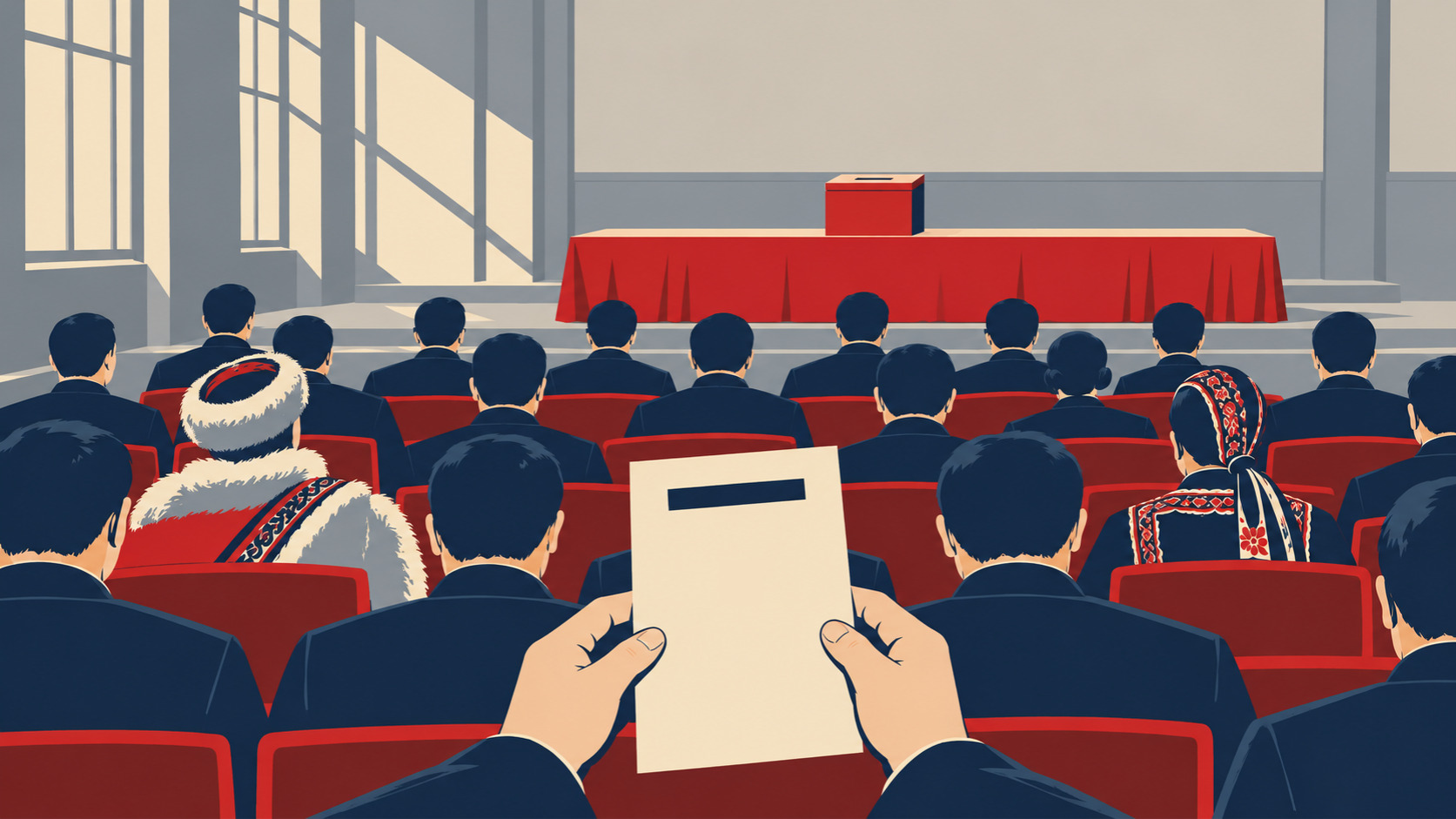
Picture yourself as one of 1,226 deputies, the members elected to sit in a congress. It is September 27, 1954, in Beijing. You are in Huairen Hall at the first meeting of China's new National People's Congress. In your hand is a ballot for Chairman of the People's Republic of China. It carries one name: Mao Zedong. You may vote for him, vote against him, or abstain. The ballots are counted. For Mao: 1,210. Against: 0. Abstaining: 0. The deputies were not picking between two men. They were the only name on the paper. So if a ballot holds one name, what is the vote for? Here is what was at stake. Five years earlier, the Chinese Communist Party had won a long civil war and founded a new state, the People's Republic of China. To get ready for its first national election, that state counted its people: 601,938,035 of them. Its leaders promised that the vote would belong to the people. Who counted as "the people" would decide everything that followed. At MockElection.com we want to make you a scholar of the republic. Let's see how another people chose.
A People's Republic and Its Promise
In 1949 the Chinese Communist Party, led by Mao Zedong, won its civil war against the Nationalist government of Chiang Kai-shek. The Nationalist government retreated to the island of Taiwan. On June 30, 1949, a few months before the new state was declared, Mao published an essay for his party's twenty-eighth birthday. He called it "On the People's Democratic Dictatorship." In it he told the country who would rule it and who would vote.
The party carried the name Communist, but the new state described its road as socialism. The two words named two stages of one plan. In 1875 Karl Marx, a German writer, described them in a short work, the Critique of the Gotha Programme. In the first stage, he wrote, each worker would be paid by the work he did. In a higher stage, society would live by a new rule: "From each according to his ability, to each according to his needs!" Later the Russian revolutionary Vladimir Lenin gave the first stage its usual name: socialism. In socialism, the state owns or runs the land, the factories and trade. It pays each person by his work. The higher stage was communism. It would be a society with no private property. Marx's followers believed the state itself would wither away. So the party was named for its , and the state was named for the first stage on the road there.
China's new leaders wanted a country that moved as one toward a single plan. Which would you rather a new country's first election show?
Six Hundred Million Counted
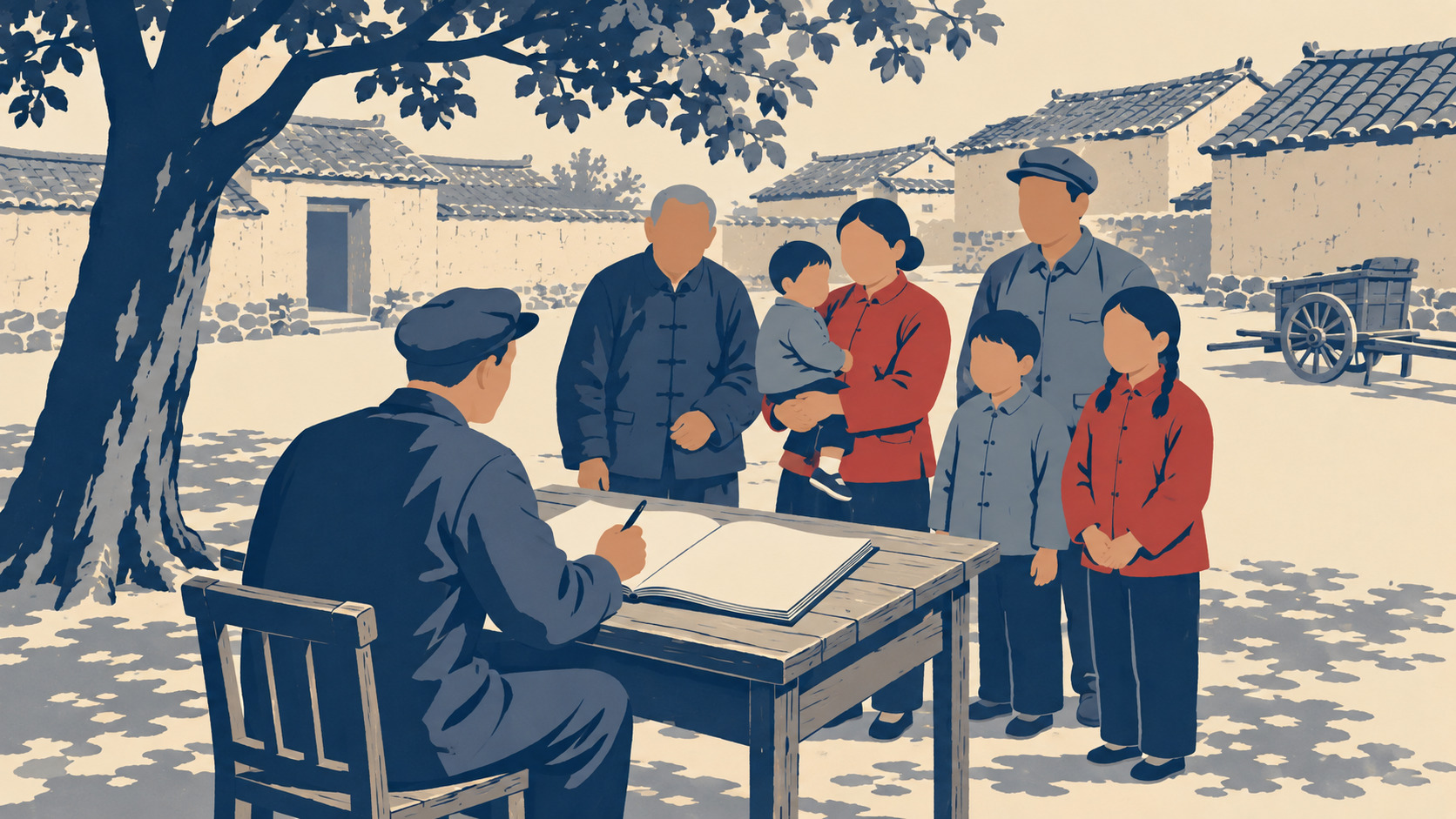
Before China could elect a congress, it had to know two things: how many people it had, and who could vote. The Central People's Government approved an Electoral Law on February 11, 1953, and published it on March 1. Every citizen who had reached the age of eighteen could vote and be elected, no matter his nationality, sex, job, religion, schooling or property. The law named its exceptions, too. Counter-revolutionaries who had been deprived of political rights by law could not vote, and neither could others the law had stripped of those rights.
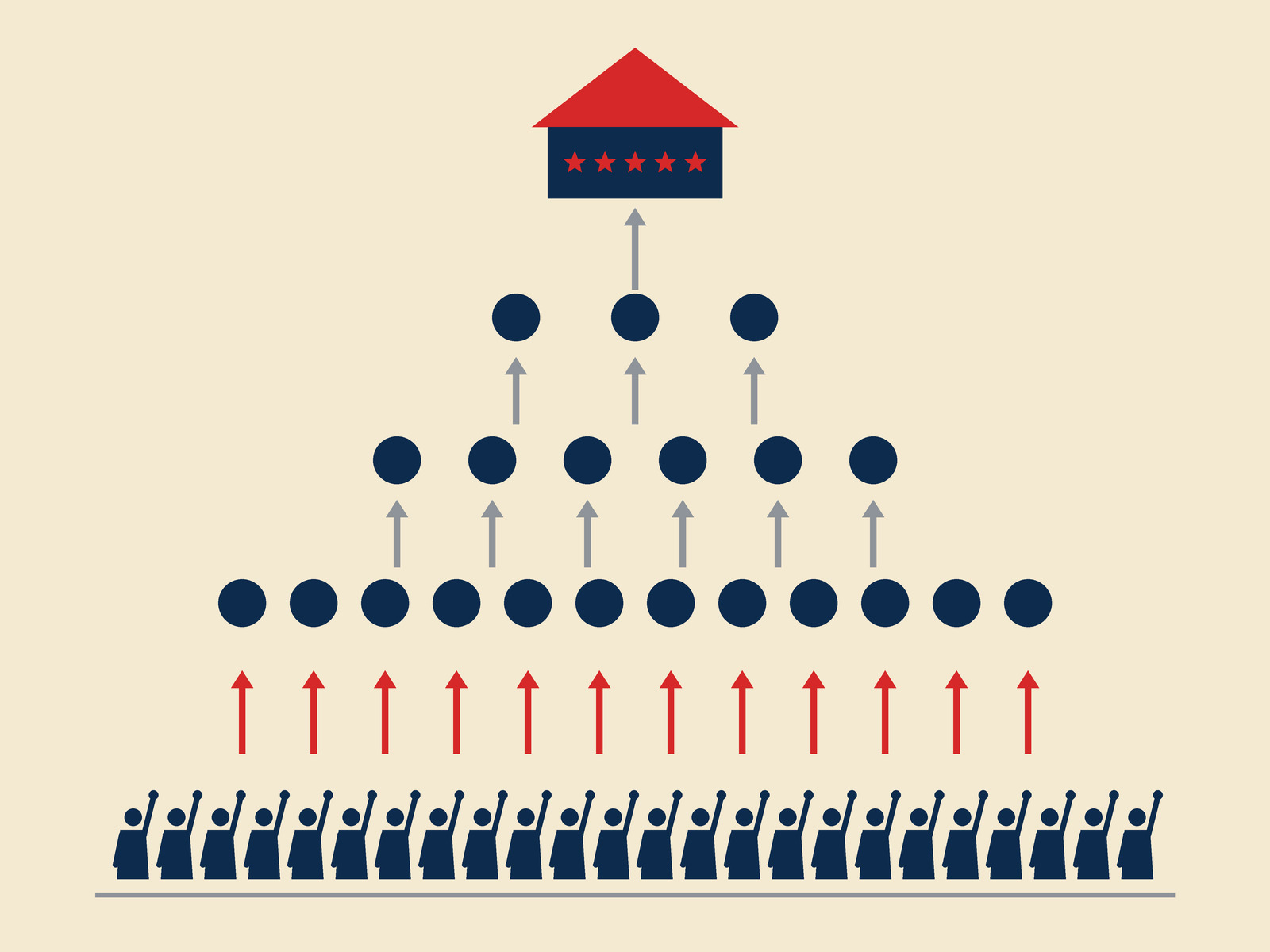
Then the government counted. It set one moment for the whole country: midnight at the end of June 30, 1953. The census and the voter rolls were made together, because the count was taken to prepare for the election. The total, announced on November 1, 1954, came to 601,938,035 people. More than 323 million citizens were registered to vote, about 97 percent of everyone eighteen and older. Voting began in March 1953 and did not end until August 1954. In more than 214,000 local units, 85.88 percent of the registered voters took part.
The ballot followed a rule borrowed from the election law of the Soviet Union. In a single-candidate election, the number of names on the ballot equals the number of seats to be filled. Voters did not choose between parties or between plans. To vote yes, a voter left the name as it was. To vote no, he crossed it out or wrote in another name. A candidate needed more than half of the votes cast.
Huairen Hall, September 1954
The congress opened in Huairen Hall in Beijing on September 15, 1954. Its first task was a constitution. A committee of more than 30 people, led by Mao, had drafted it, using the Soviet Union's constitution of 1936 as its model. The draft had been sent out across the country. About 150 million people took part in discussing it, and they sent in more than 1.16 million questions and suggestions. On September 20, 1954, the deputies adopted the Constitution of the People's Republic of China. It promised a gradual transition to socialism. It made the National People's Congress the lawmaking body in the country. The congress would be elected for four years, and it would elect the Chairman of the People's Republic.
On September 27 the deputies voted. Mao Zedong was elected Chairman of the People's Republic. The count was 1,210 votes for, 0 against, 0 abstaining. Zhu De was elected Vice-Chairman. Liu Shaoqi was elected chairman of the congress's Standing Committee, and Zhou Enlai became Premier, the head of the government. The session closed on September 28. Feel the weight of that for a second. Of 1,210 ballots, not one was marked against the man whose name it carried.
Ten Years Without a Congress
The Constitution said a new congress must be elected every four years, and at first one was. In April 1959 the second congress met, and on April 27 it elected Liu Shaoqi Chairman of the People's Republic. Mao gave up that office but remained chairman of the Communist Party.
A disaster was already spreading through the countryside. In 1958 the party began the Great Leap Forward, a campaign to drive up farm and factory output. A famine followed, from 1959 to 1961. In the spring of 1961, Liu went home to Hunan to see it for himself. The villagers told him there had been no drought there the year before. Liu came back convinced that the famine had been caused mostly by . On January 27, 1962, he spoke to more than 7,000 party officials in Beijing. He repeated what the people of Hunan had said: the disaster was "three-tenths natural calamity and seven-tenths man-made."
In May 1966 Mao launched the Great Proletarian Cultural Revolution. He called on young Red Guards to attack party leaders he said had taken the capitalist road. On August 5, 1966, he wrote a poster titled "Bombard the Headquarters," aimed at Liu. Between August and November he received an estimated 11 million Red Guards at eight rallies in Tiananmen Square. Liu was brought before criticism meetings, the public denunciation rallies of those years. On October 31, 1968, he was stripped of every office and expelled from the party.
The congress stopped meeting. The third National People's Congress had opened on December 21, 1964. The fourth did not open until January 13, 1975, more than ten years later. From 1966 to 1971, local and provincial congresses stopped working, and power passed to Revolutionary Committees of army officers, mass-organization leaders and party veterans. The fourth congress's 2,864 deputies were not chosen by the old ladder of elections. They were chosen by consultation among party committees. On January 17, 1975, they adopted a new constitution. It placed the National People's Congress under the leadership of the Communist Party of China. It abolished the office of Chairman of the People's Republic, the office Mao had won 1,210 to 0 and Liu had held. The duties of head of state passed to Zhu De, chairman of the Standing Committee.
In the middle of those years, President Richard Nixon of the United States came to China. He arrived in Beijing on February 21, 1972, and met Mao that same day. He was the first American president to visit mainland China while in office. On February 28 the two governments issued the Shanghai Communiqué, a first step after many years of hostility. China's leaders received the American president without changing the way they chose their own.
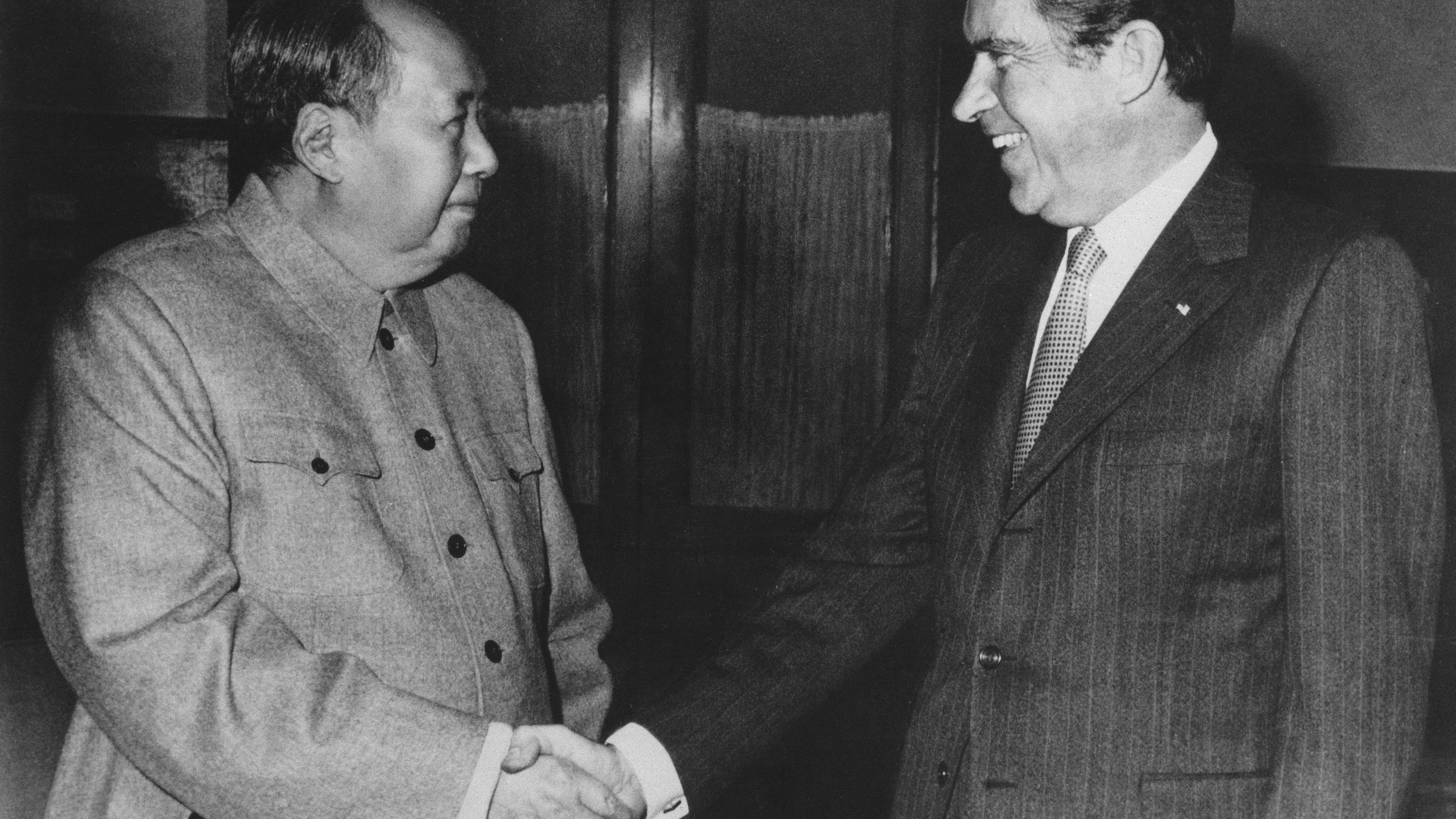
The Honesty of a Silent Mark
The virtue this election tested was honesty: making your words and your marks match what you actually think. A vote is an honest record only when the mark says what the voter . Look again at Huairen Hall. The count, 1,210 to 0, tells us what the deputies marked. It cannot tell us what each of them thought, and no record can.
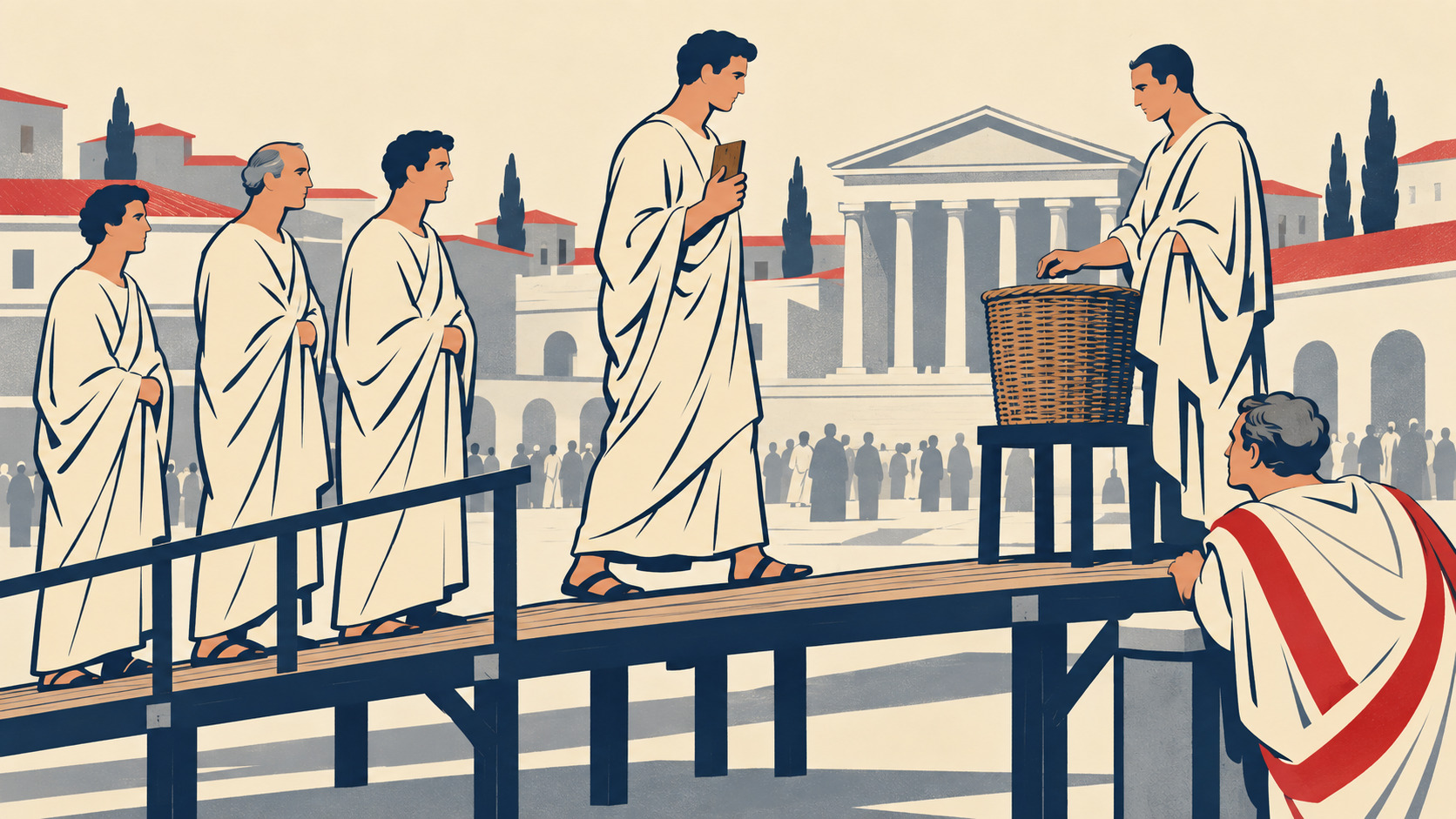
The Romans worried over this long before Beijing. About AD 100, Pliny the Younger, a Roman senator, wrote to a friend praising the secret ballot in the Senate's own elections. Then he added a warning. Few men, he wrote, are "as careful of acting honourably in secret as in public." A secret mark protects an honest voter. It cannot make a voter honest, and it cannot add a second name to the ballot.
Liu Shaoqi practiced honesty in an open hall, not behind a curtain. In January 1962 he told more than 7,000 officials what the villagers of Hunan had told him. His report laid most of the famine at the door of the party's own campaign. Here's where it tightens. Four years later the Cultural Revolution made him a target. Seven years later he was dead. In those same years truth-telling itself was turned into a weapon. At criticism meetings, people were pressed to accuse their neighbors and colleagues in public, and an accusation counted as loyalty.
Conclusion
Go back to Huairen Hall on September 27, 1954: one name, 1,210 ballots, and not one marked against it.
How the map changed. In 1953 and 1954, China built a ladder of congresses. It ran from more than 323 million registered voters up to 1,226 deputies. Every ballot on it carried as many names as seats. By 1975 the ladder had been set aside. The congress had gone more than ten years without a new election, and the office of Chairman was gone. Mao died on September 9, 1976. On July 1, 1979, China passed a new Electoral Law. Voters could now elect their county congresses directly. Ballots had to be marked in secret. Ordinary voters could name candidates. And there had to be more candidates than seats, between one and a half and two times as many. The single-candidate ballot of 1953 was gone. Every level still answered to the leadership of the Communist Party.
How the republic's character moved. In twenty-five years, the people of the People's Republic lived through three kinds of voting. First came a vote that confirmed. Then came a decade with no national vote at all. Then came a ballot with a second name on it. A people learns what an election is for by what its elections do. As you recall from the election of 1984, Ronald Reagan carried 49 states that November. Six months earlier, from April 26 to May 1, 1984, he toured China. He was the third American president to go there, after Nixon in 1972 and Gerald Ford in 1975. On April 30 he spoke to the students of Fudan University in Shanghai. It was one election in the whole true history of the vote. China's single-candidate ballot of 1953 was borrowed from the Soviet Union. In the next lesson you will see what happened there in 1989, when Soviet voters were handed a private booth and the power to cross out the party's men.
To live well is to let your mark say what you mean, whether anyone is watching or not.
Because elections are won and lost.
Parties rise and fall.
But the republic rests on its citizens.
Lesson Summary
Key Terms
- Deputy
- a member elected to sit in a congress.
- Socialism
- in Marxist teaching, the first stage after capitalism, in which the state owns or directs the land, factories and trade and pays each person by his work.
- Communism
- in Marxist teaching, the higher stage, a society with no private property in which the state would wither away; the goal the Chinese Communist Party was named for.
- Democratic centralism
- the party rule that members may argue a question while it is discussed, but must carry out the leaders' decision once it is made.
- People's congress
- an elected assembly at one level of China's government, from the township up to the National People's Congress.
- Indirect election
- an election in which voters choose deputies, and those deputies choose the members of the next body up.
- Single-candidate election
- an election in which the ballot carries exactly as many names as there are seats, so the voter approves or rejects but does not choose.
- Secret ballot
- a vote marked in private, so no one else can see it, as Rome's ballot law of 139 BC began.
Cause-and-Effect Chart
| Key Fact | The Cause | The Effect |
|---|---|---|
| 601,938,035 people counted | The Electoral Law of 1953 needed to know who could vote | The census and the voter rolls were made together |
| Mao elected Chairman 1,210 to 0 | The ballot carried one name | The vote confirmed one man rather than choosing between rivals |
| No new congress opened from December 1964 to January 1975 | The Cultural Revolution set the state's institutions aside | The 1975 Constitution placed the congress under the party's leadership |
| Liu Shaoqi stripped of office in 1968 | Mao named him a target of the Cultural Revolution | The office of Chairman was abolished in 1975 |
| The Electoral Law of July 1, 1979 | China rebuilt its elections after the Cultural Revolution | More candidates than seats, and direct elections for county congresses |
Timeline
| Person / Event | Date (AD) | Description |
|---|---|---|
| Mao's essay on the people's democratic dictatorship | June 30, 1949 | Mao writes that the vote belongs only to the people, not to the reactionaries. |
| The Electoral Law is published | March 1, 1953 | Every citizen eighteen and older may vote, except those deprived of political rights by law. |
| The census moment | June 30, 1953 | China counts its people at midnight; the total, announced in 1954, is 601,938,035. |
| The Constitution is adopted | September 20, 1954 | The first National People's Congress adopts the Constitution in Huairen Hall. |
| Mao elected Chairman | September 27, 1954 | 1,210 for, 0 against, 0 abstaining. |
| Liu Shaoqi's report | January 27, 1962 | Before more than 7,000 officials, Liu blames the famine mostly on people, not nature. |
| Nixon meets Mao | February 21, 1972 | The first American president to visit mainland China while in office meets Mao in Beijing. |
| The new Constitution | January 17, 1975 | The congress is placed under the party's leadership, and the office of Chairman is abolished. |
COMMAND QUESTIONS
Factual Recall
The "Why" Questions
Write a short paragraph answering each question in your own words, in your notebook. Then check its box: +4 each.
Why could a village voter in 1953 choose a deputy for his township congress but not for the National People's Congress? Use the ladder of congresses in two or three sentences.
The Constitution of 1954 said a new congress must be elected every four years. Using the text, explain why no new congress opened for more than ten years after December 1964.
Cast Your Ballot
you are a deputy to the first National People's Congress on September 27, 1954 — the ballot carries one name; vote for him, vote against him, or abstain; the congress elects
Loading…
The ballot: 1954 — Chairman of the People's Republic of China (one name; vote for, against, or abstain)
Mao Zedong — Chinese Communist Party — Chairman of the Central People's Government since 1949 and chairman of the committee that drafted the new Constitution; the Constitution promised a gradual transition to socialism under a government of the workers and peasants
What a deputy knew on September 27, 1954:
- The Constitution adopted seven days earlier made the National People's Congress the only lawmaking body and gave it the power to elect the Chairman.
- About 150 million people had taken part in discussing the draft Constitution.
- The deputies had been chosen up the ladder of congresses, starting from more than 323 million registered voters.
- The ballot carried one name.
What the deputies decided: Mao Zedong, Chairman of the People's Republic of China — 1,210 for, 0 against, 0 abstaining; Zhu De, Vice-Chairman.
Cast your own ballot on MockElection.com — vote as a deputy of 1954, with only what a deputy of 1954 knew. Then compare your count to history.
Rome gave its voters a secret tablet in 139 BC; China's ballot of 1953 gave its voters one name for each seat. Which matters most for an honest election?
Two games wait below
Whistle-Stop
The lesson’s words, against the clock. Twelve in a row earns the Blue Ribbon.
The Canvass
Match each cause to its effect, then each event to its year. Both boards with one miss or fewer earns the Clean Count.
0 of 100 points
Kept in this browser for this visit. Sign in to keep it on any device.